Ranger's Blog 2026
September
It’s been another busy month up on Fair Isle (I think I’ve started every blog with something along those lines – it’s been a busy year!), here’s what I’ve been up to lately.
I’ve done two school sessions this month, and both have been pretty successful! The first focused on biosecurity monitoring, a key part of my job that the kids hadn’t encountered before. After a short introduction to biosecurity monitoring and its importance, we set off to check the boxes at the fire station, Upper Stoneybrek and Pund. This was quite an unusual session as the school was undergoing an inspection, so our venture around the boxes was completed with an inspector and the headteacher in tow! We found mouse sign on a couple of the blocks and the kids were great at spotting even the tiniest nibbles on the wax. The second school session involved a large number of small plastic ducks. Inspired by a simple practical I had done at university, I taught the kids the scientific method of mark-release-recapture using a bag of ducks and some sharpies. This involved choosing a first sample number, removing that number from the bag, marking every duck, replacing them all back in the bag, shaking the bag to mix the ducks up, choosing a second sample size number and then counting how many of the second sample were marked. They got very into this, and it was some excellent counting practice for the younger kids, with the older kids getting stuck in to the calculations necessary to come up with a population size estimate. We then counted the ducks to see how accurate our estimate had been and then tried again with some larger sample numbers to see if it would make our estimate more accurate. Our initial estimate had been 74 out, but the second estimate was only 18 off the true number!
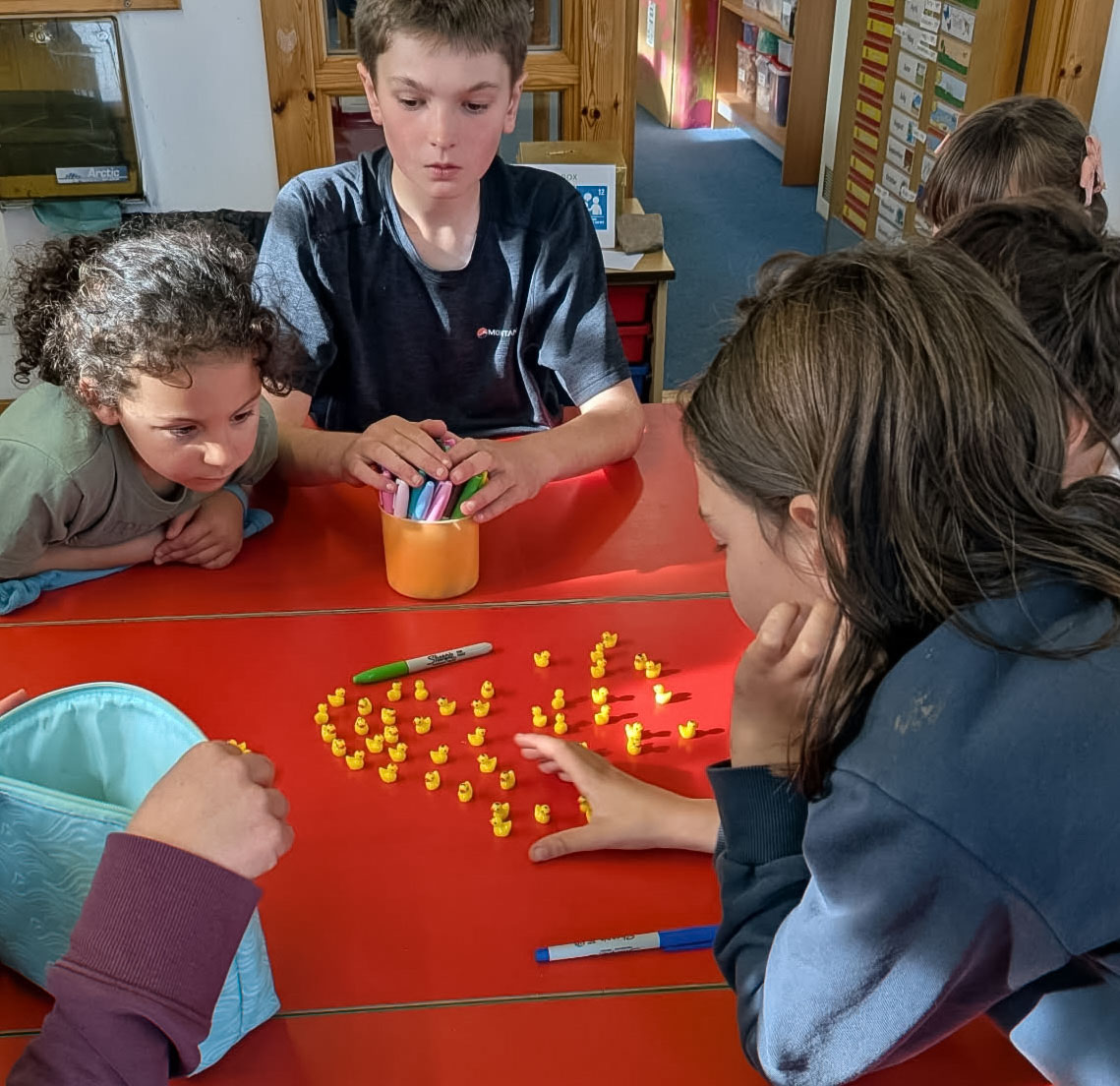
Serious duck considerations making sure we’ve marked every duck from our first sample (Jonathan Pye)
It’s been another good month for guided walks, with takers for most I’ve written up on the board even with the number of birders at the Obs steadily increasing. I tend to be much busier with walks the more non-birders we have, as most of the birders know their way round pretty well already and would rather be doing their own thing birding anyway! It’s been a pretty even split in terms of popularity of the different routes with my three main routes - Central Island, Vaasetter, and North Light - all going ahead five times each. Some walks have included some great views of scarce birds, with Rosefinches showing well on two occasions, then a Yellow-browed Warbler on another, and the mushrooms and other fungi popping up all over the island have provided another interesting focal point. The weather hasn’t always been so good however, with several walks involving torrential downpours and a thorough soaking for everyone involved, though each time conditions brightened up nicely meaning we’d dried out by the time we returned to the Obs.
Regular Museum opening hours have now stopped for the year, with my last regular shift on 18th. I have been opening the Museum for groups of interested Obs guests every few days since, often when the weather is worst, ensuring that nobody who is keen to go misses out. All of my Museum shifts this month have been busy with Obs guests, and the times when I’ve opened the Museum since have been very popular!
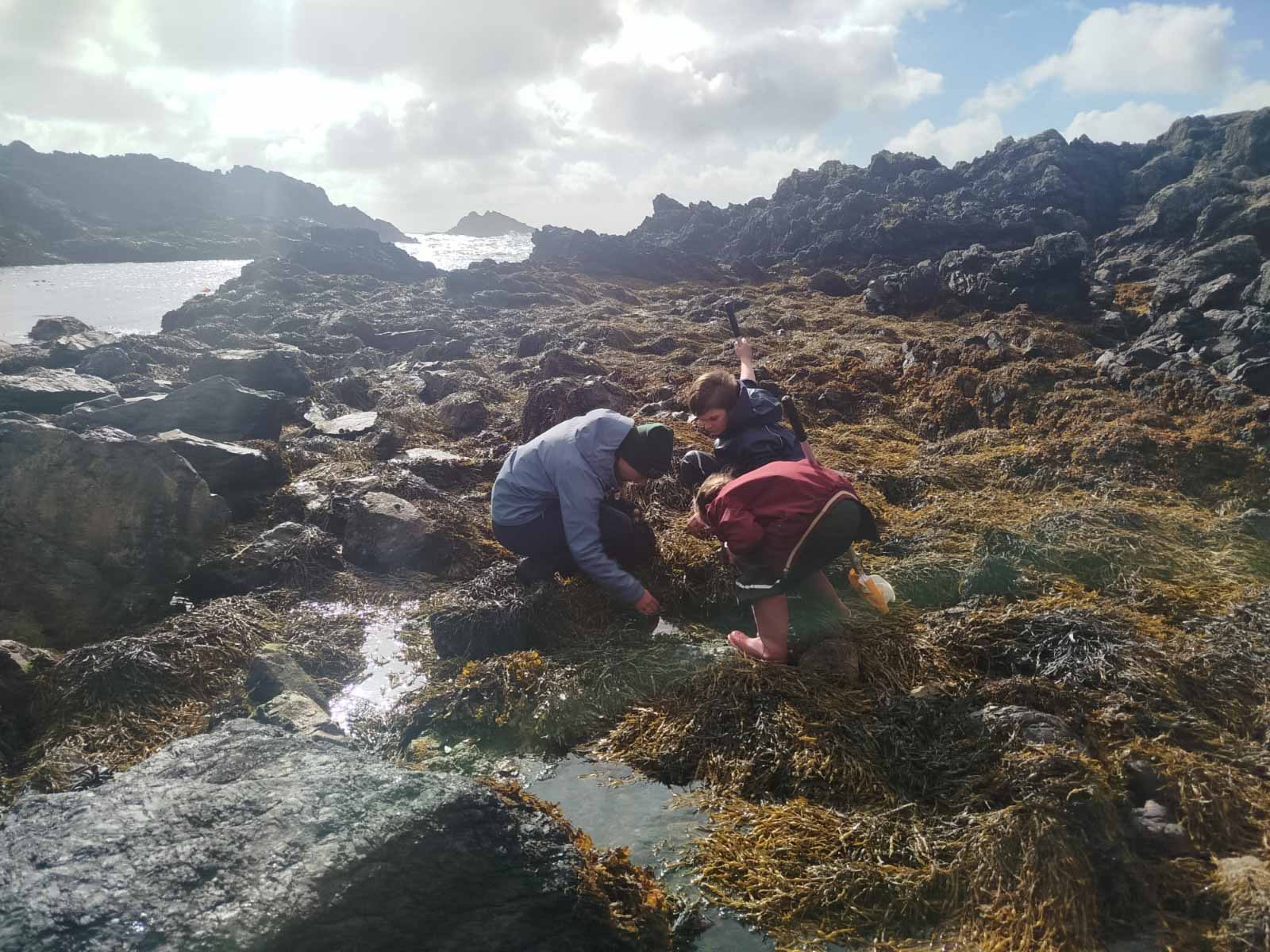
Having a look for some rockpool creatures to photograph for the Bioblitz (David Parnaby)
This past month has also involved some collaborations with FIMRO Education Officer David Parnaby, starting with a FIMRO-led rockpooling Bioblitz of Muckle Uri Geo, with all sightings logged on iNaturalist as part of the Rockpool Project Bioblitz Battle. A few Obs guests joined for this and there were some good discoveries in the rockpools, with 47 species recorded. We also completed a couple of beach cleans for the Marine Conservation Society Great British Beach Clean, the first with the school, again at Muckle Uri Geo which is their ‘adopted’ beach. This saw a good turnout of islanders and Obs guests, and a couple of bags of litter collected as well as two Small-spotted Catshark egg cases found by the kids. The following day I tackled North Haven and David took on South Harbour with his daughter Grace, though both locations saw much smaller turnouts, with a collective 3 extra volunteers between the two sites. Despite North Haven appearing to be pretty clean, with the help of one of our guests I still managed to collect 2.6kg of litter!
My Gannet plot visits are getting much quicker to do now as more chicks leave the nests – my last visit of September had only 27 chicks remaining between my 5 plots! By my first visit of October the number left could potentially be down to single figures, though a couple of these are rather small chicks who unfortunately are probably unlikely to survive to fledge due to hatching so late and the slow-developing nature of Gannets. From hatching to fledging takes 12 weeks, so a chick that is only 4 weeks old now doesn’t have great odds. However, there is some good news in that my adopted sibling Gannets have fledged! For those that haven’t heard about them before, the adopted sibling Gannets are from a nest where a second chick fell into the nest and the parents raised both chicks together, an unusual occurrence and one that I have written a short article for British Birds about! After our Fulmar tags continued to give us data for much longer than we had anticipated, two checks in the first half of September drew blanks for anything having been picked up, so I was able to collect in the base stations and the field aspect of the project is now completed.
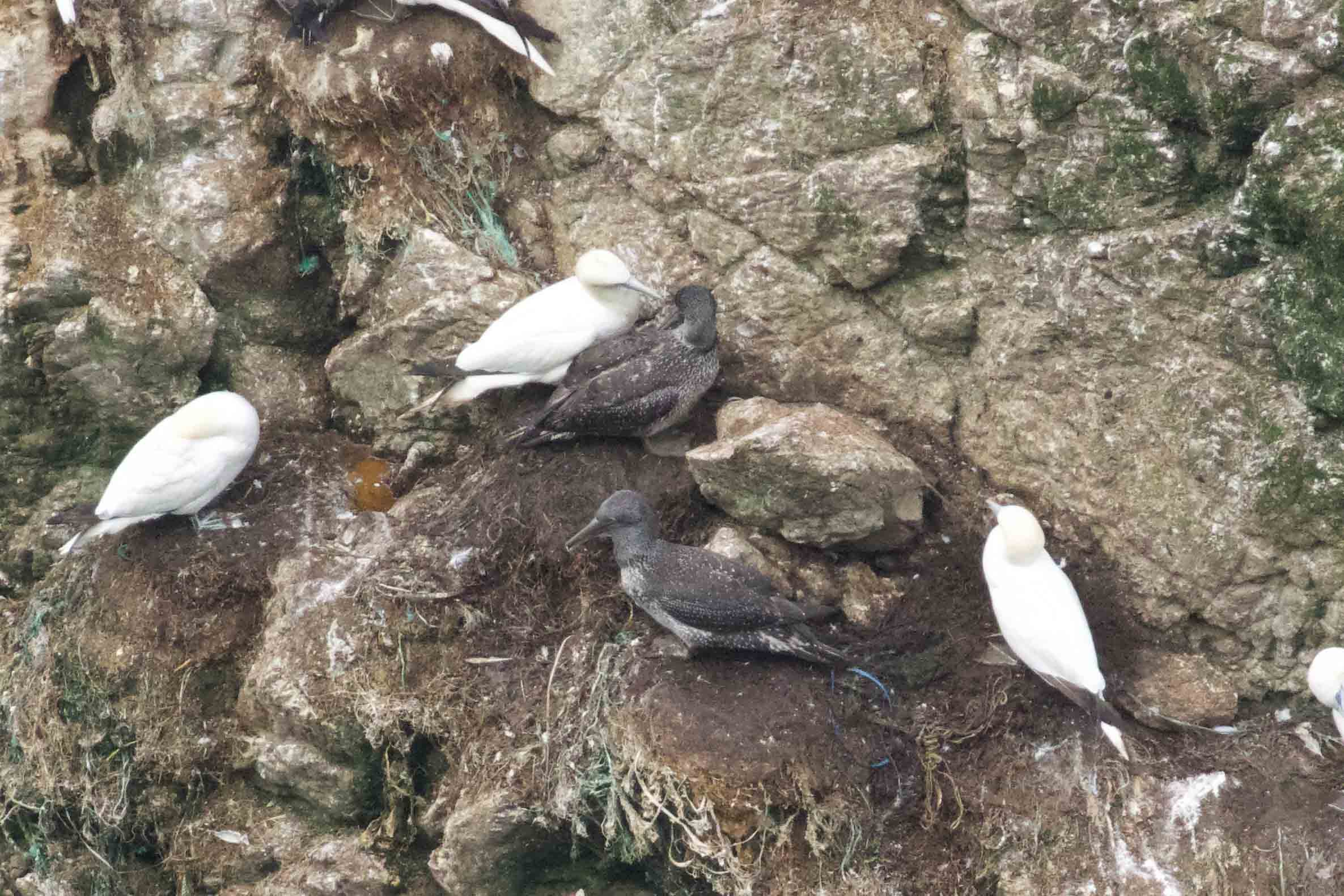
The last time I saw my adopted twin Gannets before they ventured out into the big wide world (Carla Hill)
September has been a quiet month in terms of birds, with our first Log 'write-in' species, American Pipit, not arriving until 21st. August ended well after my last blog post, with 31st bringing me a much anticipated ringing tick in the form of a Red-backed Shrike, and then a thorough search through the Walli Burn in search of a mystery crake Luke had seen briefly that morning resulting in Tom hand-catching a Corncrake, a very cool bird to see in the hand! Another highly anticipated ringing tick followed a few days later – a Tree Pipit! This was an excellent learning opportunity for me as I really struggle with telling the difference between Meadow and Tree Pipit and had only knowingly seen my first Fair Isle Tree Pipit a few days earlier, so getting a good look at the differences in the hand was a great chance for me to learn how to identify them. With sunset creeping ever earlier, the boys have been taking the chance to go out dazzling waterfowl and waders at night whenever the conditions are right. One night, Tom returned with a few birds as he’d caught a Moorhen but hadn’t taken the Moorhen colour rings out with him, leading me to get to ring my first Teal as well as a Mallard. The end of the month finally bought us some south-easterlies, and as a result plenty of birds, including an Eyebrowed Thrush! Unfortunately, like many of our guests, I failed to catch up with the best bird of the day. A small bird on the expansive cliffs of Guidicum in high winds doesn’t make for easy viewing! As I write this on the day after it is pretty wild outside, so hopefully the wet and windy conditions keep the birds here overnight for some more finds and some (hopefully more successful!) twitching in the much calmer weather tomorrow. I’m yet to find a bird this season so I also wouldn’t mind finding a bird of my own!
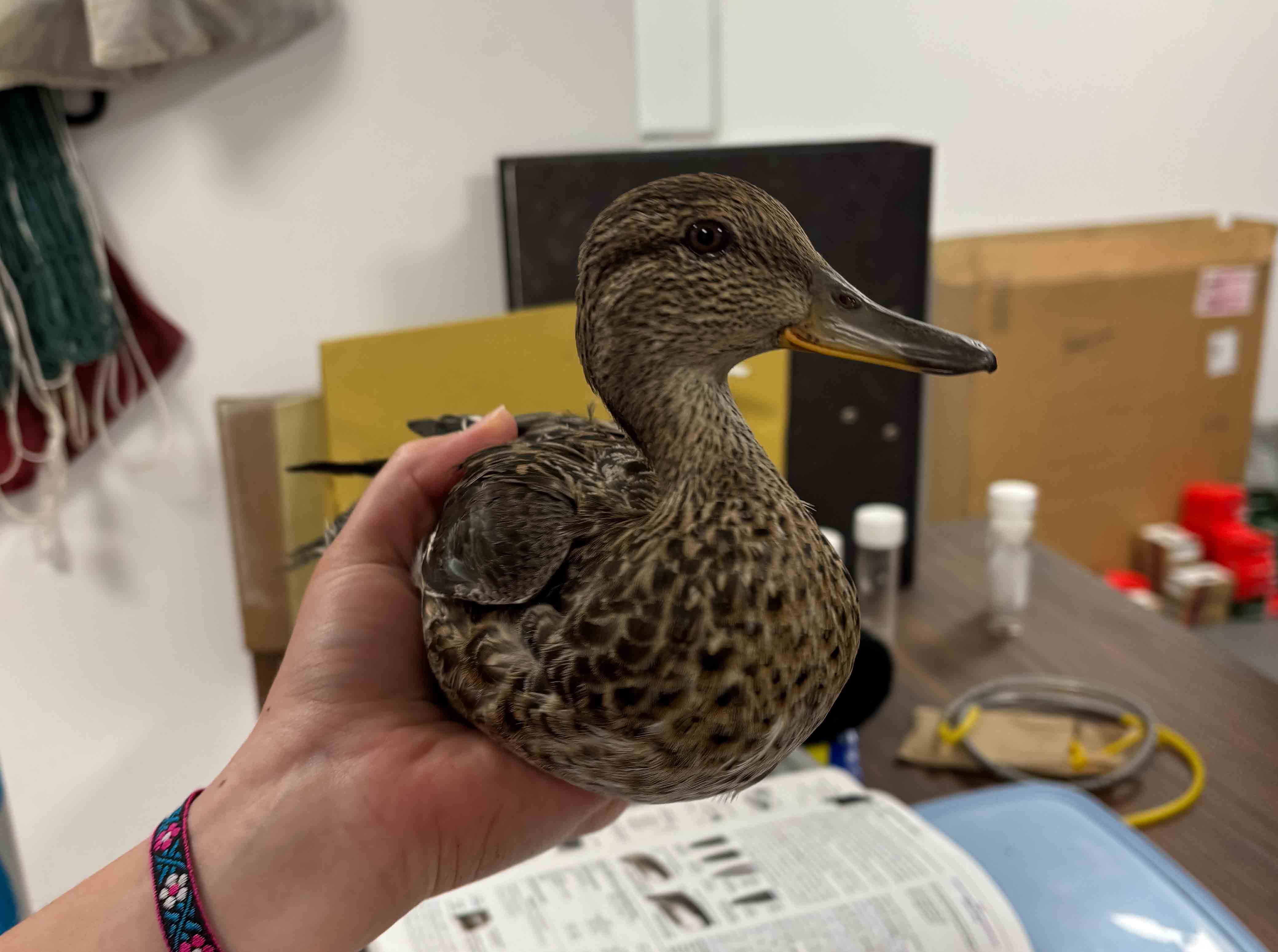
The lovely female Teal I got to ring, it doesn’t get better than ducks! (Carla Hill)
I’ve also had a few other jobs to work my way through, as well as helping the boys with some more practical jobs. My biggest job lately has been creating an inventory of our Library. Following the loss of the Observatory library in the fire in 2019, we’ve had a lot of books donated to build our Library back up. However, this has resulted in more books than we can currently fit in the bookshelves and a large number of duplicates, so a spreadsheet with title, author and category as well as how many copies we have of each book was becoming necessary to keep track of what we have. I’ve also recently put together some leaflets with self-guided walk routes, the same routes I do for my guided walks but for guests to be able to do them independently if they wish. We ordered some of these from a printing company in bulk, 50 copies of each, leaving me with 250 leaflets to fold. These are now available by the Ranger board in the Observatory. We’ve also fitted in some trap work, putting a new roof panel on Plantation, and have fitted a new boardwalk in the Observatory garden.
A staple September event in the Fair Isle calendar is the Harvest Festival, and this fell on the 27th. The islanders all pile into the hall for a few hours, and Obs guests and any other visitors are always welcome to attend too! By the door the School had a stall with three games – guess the weight of the cabbage, and then the slightly less conventional guess the name of the cabbage and guess the animal that ate the other cabbage. With the weight competition prize being the cabbage itself and me not really having any use for a large cabbage I opted for the other two games, choosing Clara for the name (would be rude not to when it’s a remix of my name and a name I commonly get called by accident!) and tree frog for the animal (one of the kids loves frogs so it felt like a very good option!). There is then a raffle with an abundance of prizes on offer, a table full of cake along with tea and coffee, and another table full of produce and home bakes available for purchase at the end. The kids play a game to win a bottle of Irn Bru, with whoever slides a 10p coin closest to the bottle winning it, and this is repeated with whisky and £1 coins for the adults. Both games made for great spectating, being incredibly close! I unfortunately didn’t win anything on the raffle or the kids’ games but it was still a lovely afternoon (with some great cake!) and over £1400 raised to be split between The Goodwill Children’s Village in India and Scotland’s Charity Air Ambulance.
Not long left of the season now, with only a month until the seasonal team will all be heading back home. See you all at the end of October for my final blog update!
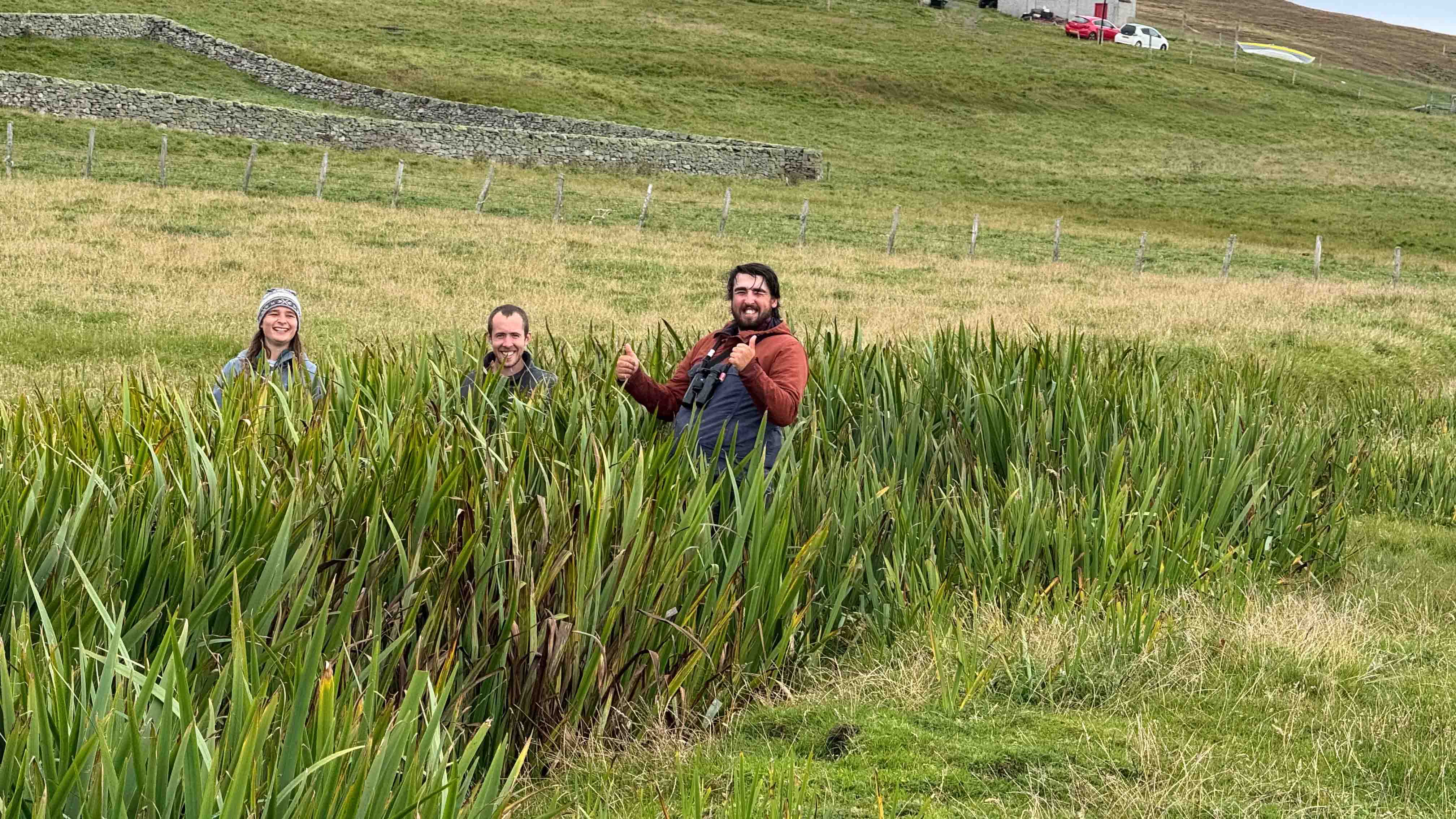
A thorough crake search through irises at some points almost as tall as us! (Alex Penn)
August
The season is flying by and somehow it's almost September already! Each part of the year on Fair Isle feels distinctly different, and with the increase of migratory birds, the shortening daylight hours, and the slowly declining weather, autumn is certainly underway.
As has been the theme of the season, it’s been another busy month, with plenty of guests and more of Marie’s knitting holidays, including a ‘dyeing week’ with an impressive 10 participants, something that sounds a little odd out of context when mentioned around the dinner table. In reality their reason for being here was far more innocent, with the knitters using natural materials including several different plants to dye wool an impressive array of colours (with hopefully no dying without the ‘e’ involved!).
I’ve been kept busy with plenty of guided walks this month, including my last two Puffin walks of the season. I always love running my Puffin walks throughout the summer – it’s a lovely way to get out in the evening in some often gorgeous lighting. When it gets to August, I’m never quite sure which Puffin walk will be my last, as it’s hard to predict when the Puffins will leave. My last one was on a lovely evening on 6th, and though Puffin numbers were sparse, at this point there were still a few birds bringing in food. Since then the numbers have been dwindling and dwindling, only 8 months until they’ll be back to begin breeding again! Numbers of people on my daytime walks have also been consistently good this month, with Vaasetter continuing to be the most popular route, evidenced by my walk up there on the 26th with a whopping 15 people! Ordinarily when I have a larger group for Vaasetter some will only join for the first part of the walk up to the top of the headland, opting out of the large number of stiles that must be navigated for the rest of the walk. This group must have been particularly keen as all 15 of them continued along the coast with me and completed the whole walk! It was a really lovely morning with a great group of guests in some of the best weather we’ve had all year, and despite being the biggest group I have ever taken out it was for sure one of my favourite walks of the season so far!
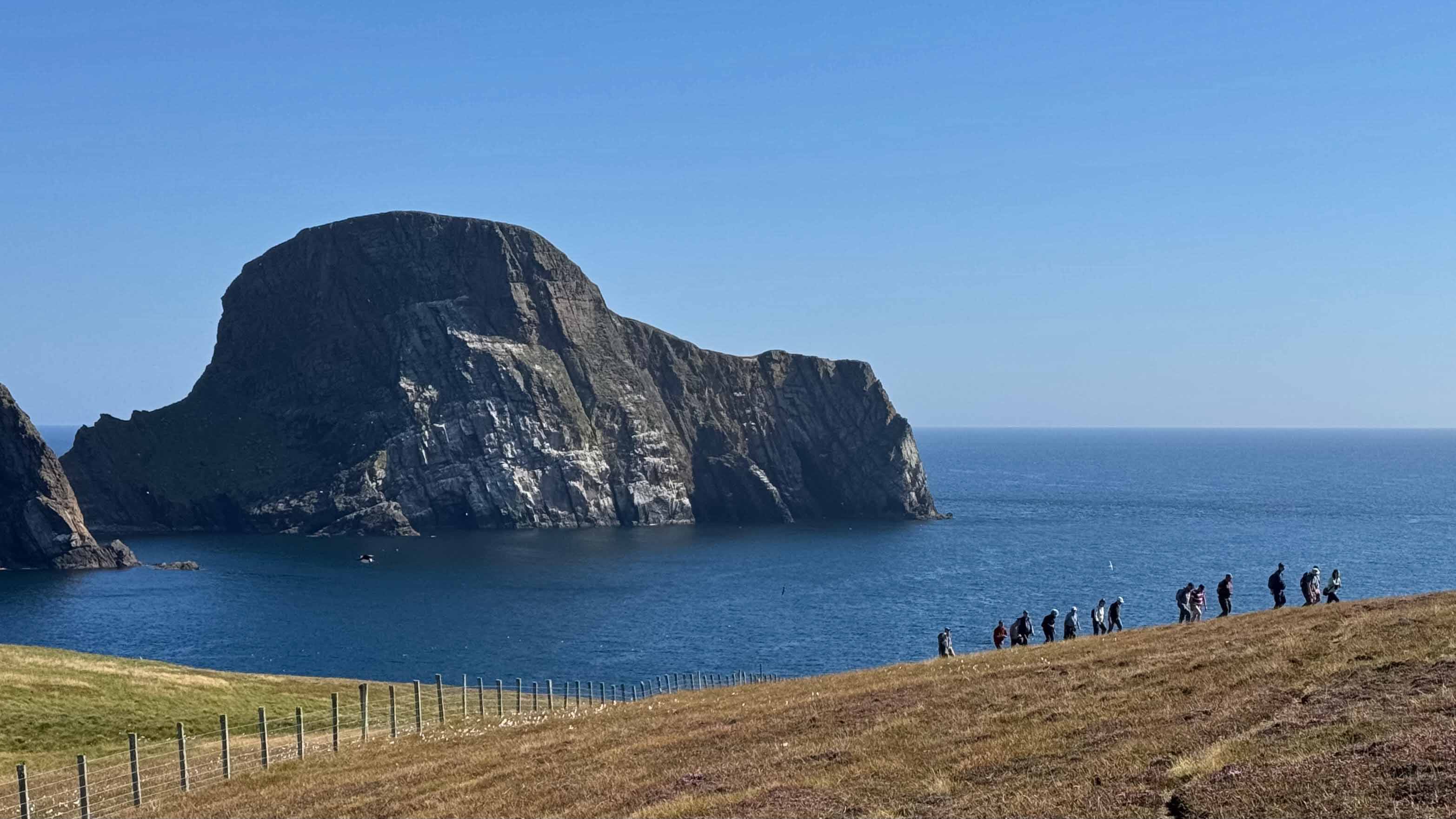
My merry band of walkers on the most well attended guided walk ever against the scenic backdrop of Sheep Rock (Alex Penn)
My museum shifts this month have been mostly on the quieter side, with only a handful of guests each time. One shift, mostly due to falling when we had no Obs guests, had no visitors at all so allowed me to spend some time giving the museum a bit of a tidy up and the floor a thorough sweep – it’s amazing the amount of grass that hitchhikes in on people’s shoes! We’ve fitted in two talks this month at times when guest numbers have been high and we’ve had the space in the library around knitting holidays. The first was quite early in the month and was Luke’s talk on the Fair Isle birding year, followed a couple of weeks later by my FIBO History talk, the third time I’d given it and arranged at short notice during a particularly busy period. The school term has just started up, so soon I will be back to delivering fortnightly sessions at the school, and with two more children this time!
This year the Obs established a new partnership with West Midland Bird Club, and as a result of this we were able to offer a 2-week volunteer placement to two 18-25 year olds from the West Midlands. Our volunteers, Ida and Megan, came for two weeks this month and got stuck straight in with everything we do here! Coincidentally they are both students at Bangor University but hadn’t met prior to getting the volunteer placement. Their experiences here included ringing a number of different birds, including both passerines and seabirds, with Bonxie chicks, Storm Petrels and Fulmar chicks to ring while they were here. They also joined in with census, as well as joining me for biosecurity box checks and Gannet productivity monitoring, helping with trap work and all sorts else. It was lovely to have them around for a while and to have some extra hands for some of my jobs!
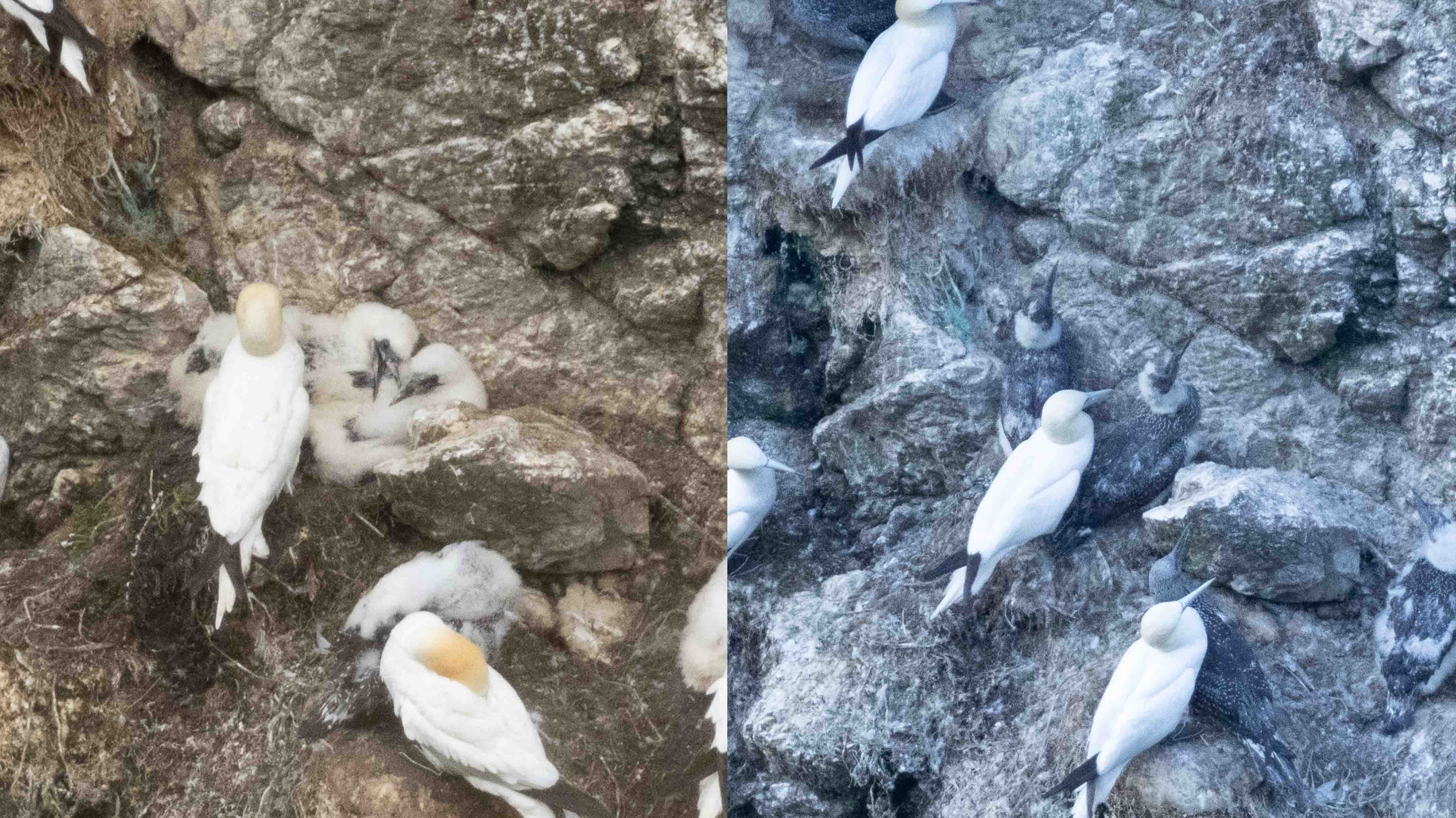
The most unusual Gannet nest of the season, this pair’s chick has gained itself an adopted sibling! The first photo was taken in early August, and the second on my most recent visit (Carla Hill)
Gannet productivity monitoring is still underway, with the first chicks finally fledging between my last two visits. A lot of chicks are now very close to fledging, and I expect to see a few more gone on my next visit, though some other chicks are still very small. One of my plots is particularly interesting, as one pair has adopted a second chick. The second chick has fallen from a different nest, but luckily for it, the nest it fell into had a chick of the same age and so the parents seem to have accepted it as one of their own – an extremely unusual situation as most Gannets would kick out the extra chick and leave it to die. The second chick has been there for more than a month now, and both seem to be growing very well – just left to wait and see if they both fledge now! At the start of the month we continued with Bonxie chick ringing, trying to get to as many of the chicks as we could before they fledged. We ended up colour ringing almost 100 chicks, and now most of our Bonxies are fledged and starting to depart from the isle. The first couple of weeks of August also saw a few more Storm Petrel ringing sessions, with a few hundred more Stormies ringed and a third Leach’s Petrel of the year also caught! That’s most of our seabird work finished for 2026 now apart from my Gannet monitoring, though back in July we had some researchers from NTS come to GPS tag some Fulmar to find out which areas they are using to forage and this project is still ongoing. The tags remotely pass on data to five base stations and since the researchers left, I have been regularly going round the base stations with a laptop to download the data. It was expected that we would have data transmission for a couple of weeks, but amazingly data is still coming in from a couple of the tags! The battery life of the tags was never expected to last this long so it’s cool to be gathering so much data for the project.
In terms of bird sightings, the autumn has really started to pick up, with good numbers of Barred Warbler and Rosefinch around the isle and scores of common migrants such as Willow Warbler, Spotted Flycatcher, Pied Flycatcher and Redstart. I was pleased to ring my first Rosefinch recently, though missed out on a second ringing tick of Blyth’s Reed Warbler due to all of the bikes already being in use so me having no way of making it to the ringing hut very quickly – still plenty of time left to catch another one! The highlight of the bird sightings so far has been a Woodchat Shrike, the 35th Fair Isle record, which hung around the Burkle area for a while. Two Citrine Wagtails was also good after us drawing a blank on those last year, though I have failed to catch up with either bird due to them being extremely mobile. Now to wait and see what the rest of the autumn might bring!
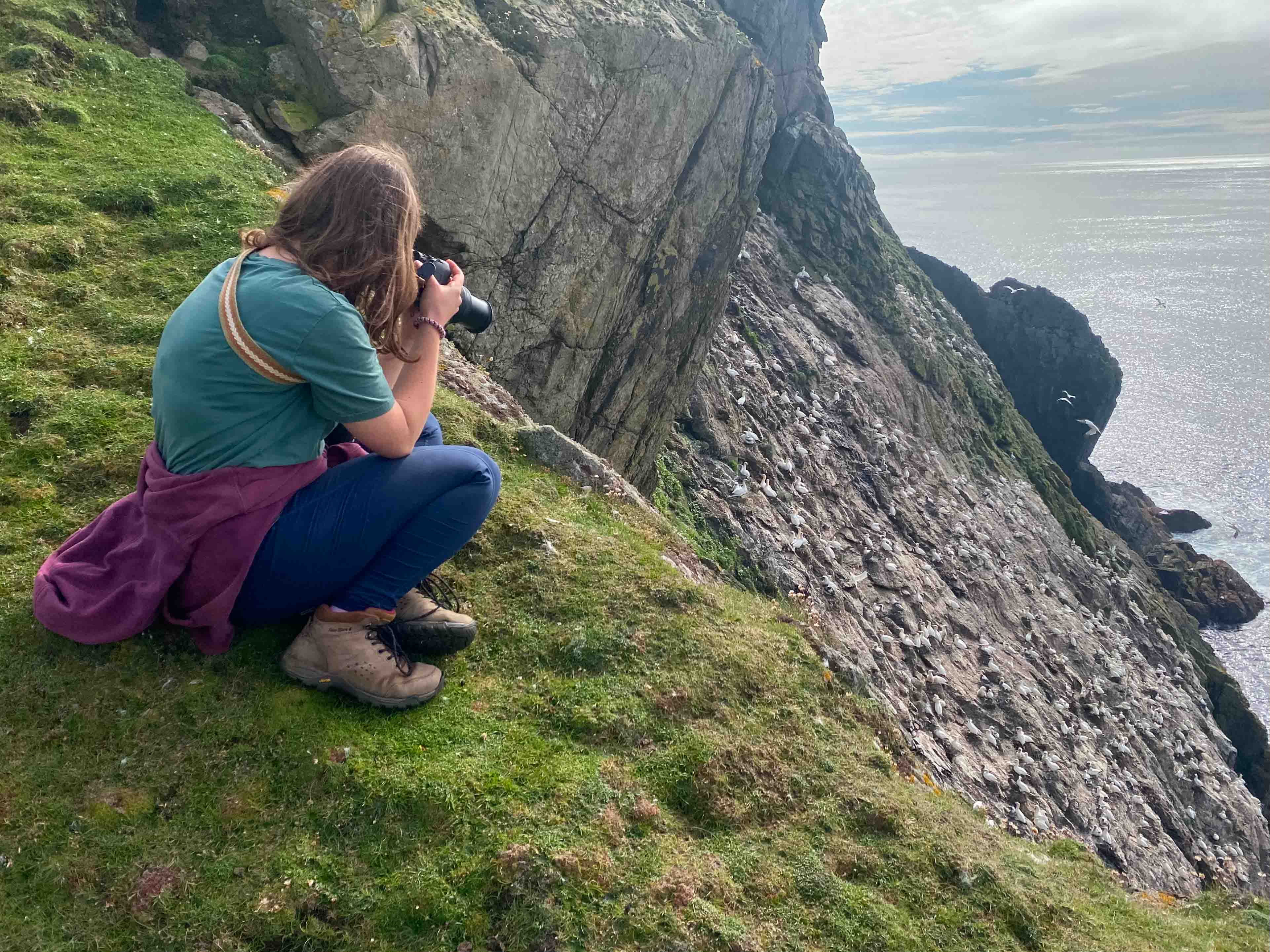
Filling up the SD card in my camera with Gannet photos (Tom Wright)
We had a few quiet days at the Obs in mid-August, three nights with no guests at all. I took this opportunity of a quiet period and no guided walk demand for a well-earned week off, though I didn’t actually go anywhere, instead choosing to dedicate my time to getting to some parts of the isle I don’t go to much. The weather, typically, was not great for the first 5 days, so lie ins, games, and plenty of chill time around some birding in the better weather was the ideal solution. However, the last two days had some much nicer weather so finally allowed me to tick off the two things I had been wanting to do in my time off the most. The first was to go and visit one of our Gannet colonies which you can get quite close to. I had known about this 'secret colony' for a while but have never had the time to go there, and it was well worth the wait, even with the smell! As much as I love Gannets, they really do smell awful, but seeing their behaviours up close was pretty special and enjoyable nonetheless. The second was a swim in Gunglesund. For those unfamiliar, Gunglesund is a large rockpool on the south coast and is the Fair Isle swimming pool. I had intended to swim in it more this year after only making it in once last year, but this ended up being my first (and probably last) swim of the year. On a nice day Gunglesund can get quite warm, but this wasn’t the case that day. I braved the water anyway (though it did take me a while to get fully in) and managed a respectable 10 lengths before I gave in and came back out into the sun. Despite not being the warmest, it was still quite pleasant!
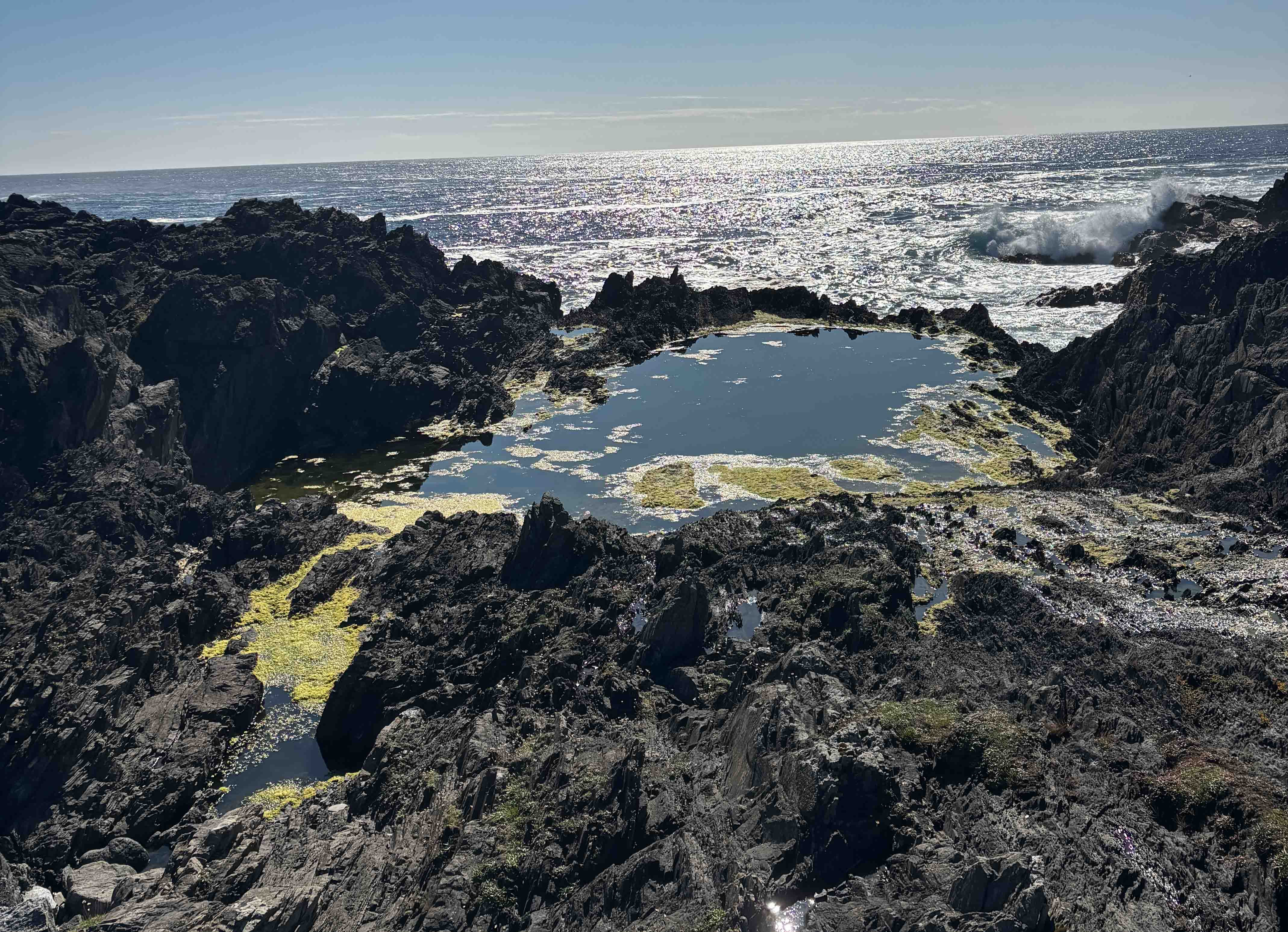
Here’s Gungesund in the sun, it looks weirdly small from this angle but is much bigger in real life I promise! (Carla Hill)
There’s also been some other fun things going on recently, one of which was a spectacle across much of Europe – the solar eclipse! We all watched it from up on Landberg with our guests and a few islanders – there must have been more than 40 of us up there! Marie had bought a big pack of those glasses that protect your eyes so we were sharing those between us, it was a very cool experience. We’ve also had a few big birthdays on the isle, which has led to two shed parties this month. If there’s one thing Fair Islanders do well, it's parties. The first was a 'back in time' themed fancy dress party for 3 people’s 50ths (dubbed a 150th birthday party), and there were some amazing costumes on show from everyone - Fair Isle loves a fancy dress party! I was dressed as Boudicca, a nod to my Norfolk roots. The second shed party was for a 30th birthday and was more focused on the food, with plenty of incredible barbecued Fair Isle lamb.
And that’s August over and out, I’ll see you in a month for my penultimate update of the season! (It’s scary saying that, time really does fly by when you’re having fun).
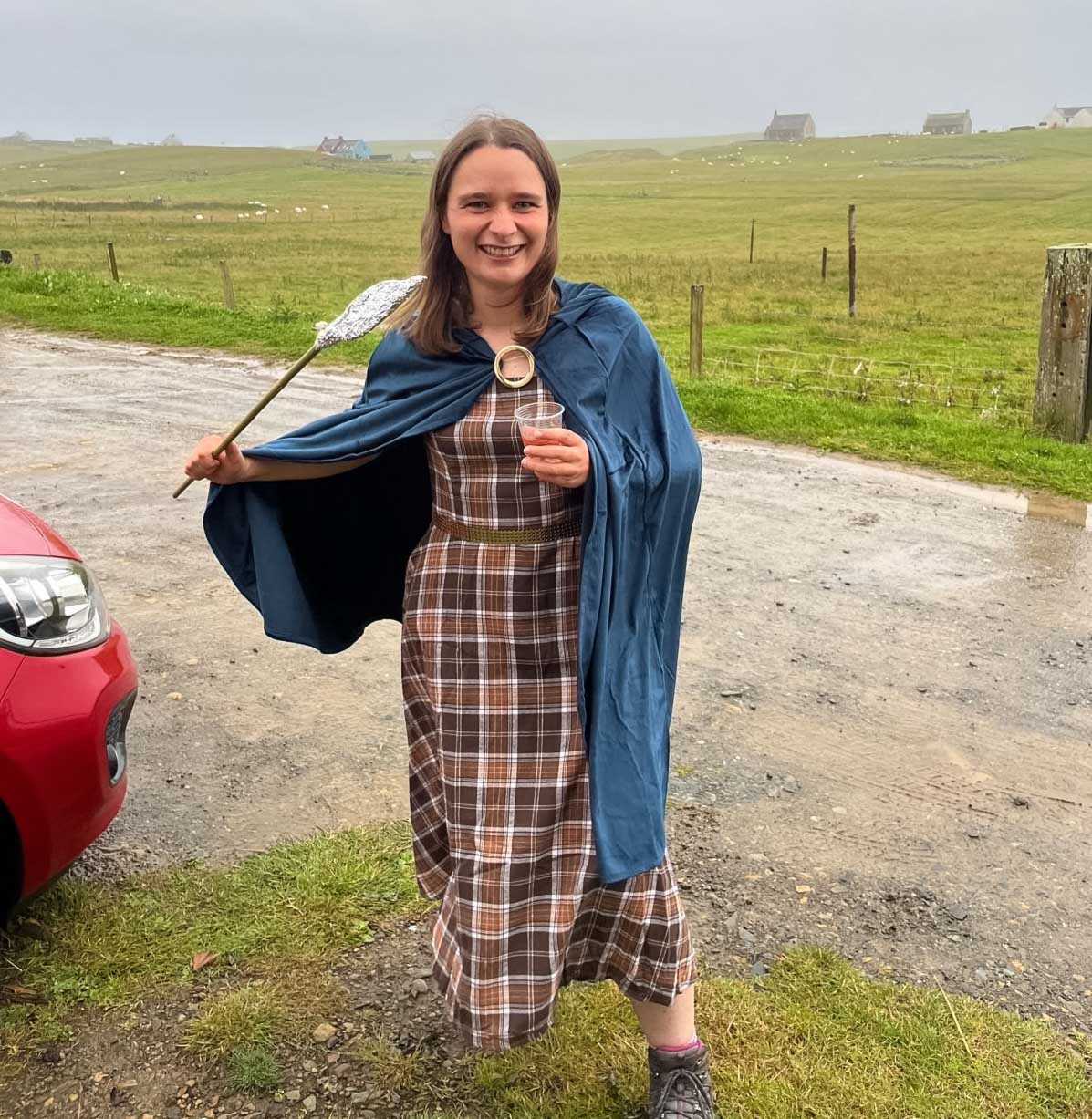
I couldn’t mention the fancy dress party without including a photo of my costume, so here it is! (Ruth Holgate)
July
It’s been another busy month at FIBO, with plenty to keep us all busy and entertained throughout!
Recently the Obs became a wedding venue temporarily for the wedding of Lachlan, eldest son of previous FIBO Warden and Administrator Deryk and Hollie Shaw. In true Fair Isle style the weather was not cooperating, with several very windy days meaning not all of the guests managed to make it in, and the band were also stuck on Shetland. The original plan had been for the ceremony itself to be outdoors, but the weather meant the lounge had to be quickly transitioned into a ceremony-friendly layout. It was a busy day, with the morning spent setting up, then a buffet lunch, the ceremony and speeches, and more food later on – the kitchen staff really outdid themselves! We were all kept busy with running and helping with the bar, moving furniture for the various stages of the day, serving prosecco, and collecting plates and glasses from around the room, as well as any other little jobs that needed doing. We were then all invited to the reception in the evening, a ceilidh at the community hall. Luckily, a band was able to be scrambled together consisting of a few musical islanders and the visiting family of a few others, so the lack of the intended band didn’t stop the festivities! It was a lovely evening celebrating, and after two run throughs of the rather chaotic dance Strip the Willow I was certainly feeling it the next day! The Sunday evening was once again busy at the Obs for a music night, and Monday night I hosted a quiz along with Fyntan, middle son of Hollie and Deryk, who had helped me write the quiz due to me not being familiar with the crowd and what rounds may go down well (I’m very used to writing quizzes for birders and islanders and this lot were mostly neither!). We managed to put together a pretty good quiz as the scores proved when all teams had done similarly well, though the victory went to a team mostly consisting of Obs staff who had absolutely smashed the music round.
It’s been a fairly busy month for guided walks, with those I’ve written up on my whiteboard having takers the majority of the time. Puffin walks lately have been great, with Puffin numbers consistently good on Buness. Not too long now until they’ll all have left! Having wedding guests around for a week or so also kept me busy taking them for guided walks around other jobs, including one Vaasetter walk with 12 participants, an impressive number! Even more impressive when one of them was a baby who was smiling the whole way round, good going for a 2.5 hour walk at that age! I’ve also had some nice busy museum shifts this month, with plenty of guests coming along to take a look and learn about the history of the isle, including some really not expecting to find me there as well as all the other things I do as part of my job! Safe to say no two days are the same for me, it certainly keeps things interesting!
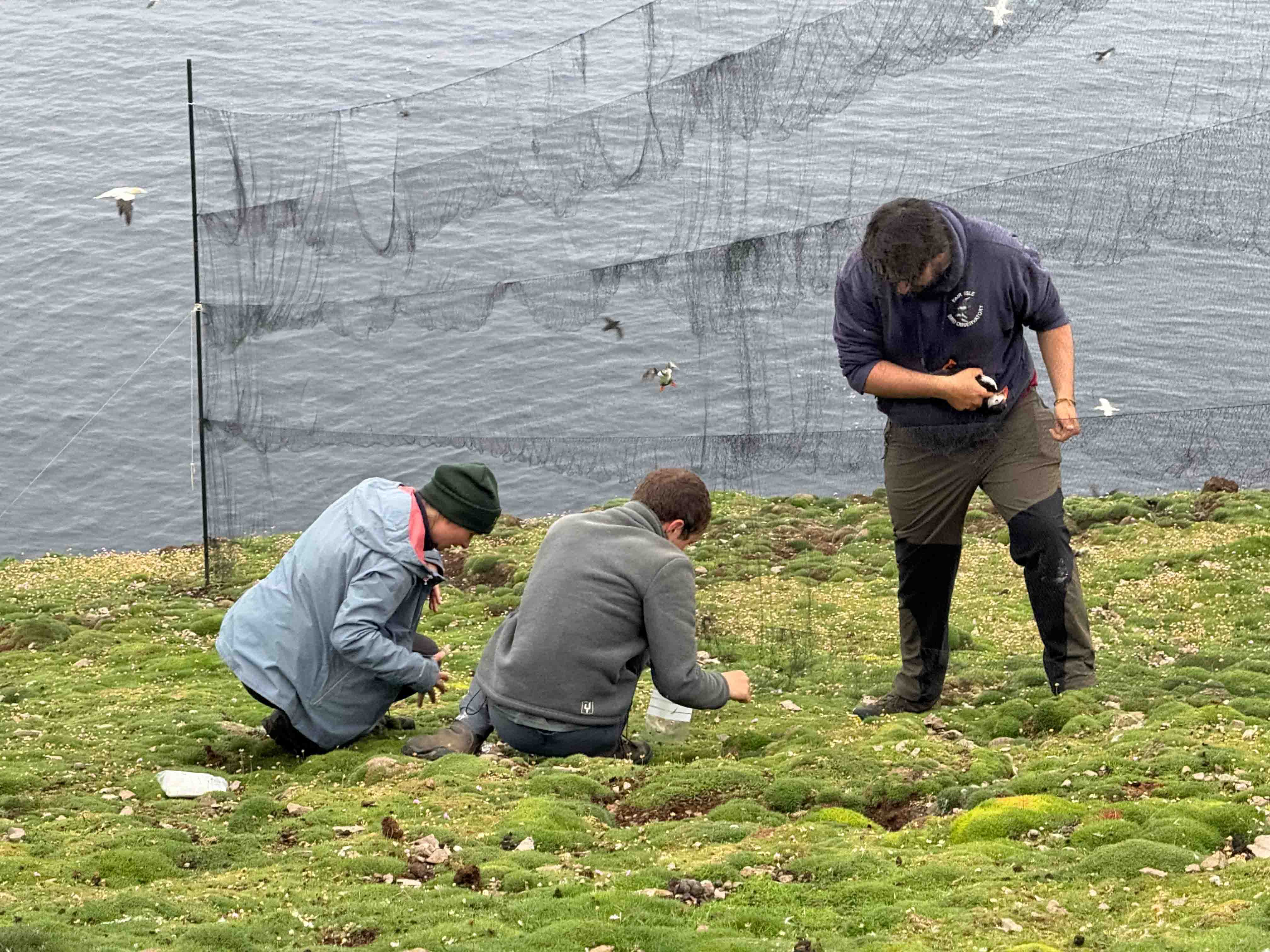
Collecting fish samples from around the net while Puffin feed sampling (Alex Penn)
All of our bigger seabird jobs have been completed this month, including feedwatches and Puffin feed sampling. We complete all day feedwatches once every year for Guillemot and Puffin, and this year we got these both done in one weekend, Guillemots on the Saturday and Puffins on the Sunday. Feedwatches are done in shifts by the four of us on the Ornithology Team, with the first shift starting at 3:30am and the last finishing at around 11pm and us swapping over every two hours. For the Guillemot feedwatch, every time a bird flies into one of the survey colonies, the time is noted, and if the bird has a fish, then if yes what kind of fish (if you can identify it) and how big it is, and the visible chicks are counted every 20 minutes. For the Puffins, around 35 burrows in the colony that are known to be active are marked with numbered flags the day before by marking burrows that birds are seen going into with fish until you have enough. On the survey day when birds fly in, the burrow number and time are noted along with what species of fish it is bringing in (if you can tell, the Puffins are rather fast!). The Puffin feed sampling works slightly differently and is a lot more hands on. It involves heading out to Tor o da Ward Hill very early in the morning. We left the Obs at 4:30am to cycle up to the mast and walk over to the Tor, then set up a mist net across the Puffin colony there. Then we’d wait until a bird flew into the net, run and collect all the fish it had dropped into a plastic bag that we then numbered, ring and release the bird, and wait for the next one. This continued until we had 30 feed samples, which took around 3 hours. The rest of the morning, after we’d had some breakfast, was then spent analysing the samples, identifying and measuring all of the fish to get an idea of what the Puffins are bringing in for their chicks.
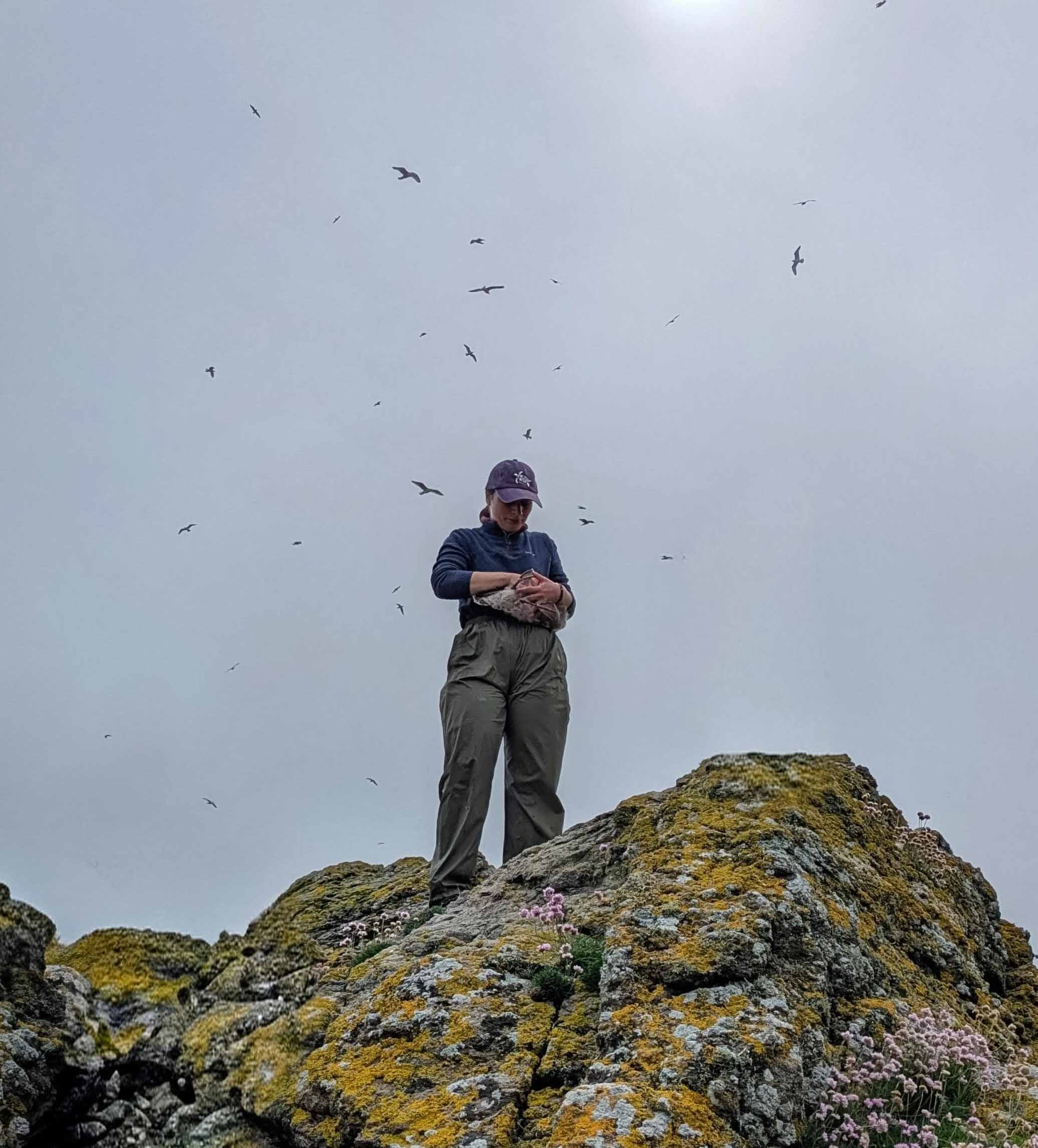
Me ringing a Herring Gull chick on Goorn (Jonnie Fisk)
Seabirds are starting to fledge across the isle, with the first fledgling Puffin of the year wandering towards the hen and stag do bonfire a couple of nights before the wedding – luckily Alex spotted it and was able to locate it to somewhere safer, darker and quieter to make its break for the sea without several people (at varying levels of drunkenness) watching it. The chicks on my Gannet monitoring plots are getting bigger, with the eldest only a few weeks from fledging, and the first of the Bonxie chicks have been seen taking their first experimental flights. We’ve been dedicating time to ringing all of the Bonxie chicks in the hopes of getting them all before they fledge and are no longer catchable, but unfortunately in terms of breeding success it’s not looking like a great year for them. I always enjoy seeking out the Bonxie chicks in their hiding spots, though with the quiet outcome of many of the breeding areas this year it’s a much more sombre activity than last year. Early in the month we also went and ringed all of the gull chicks up on Goorn, a mixture of Herring, Lesser Black-backed and Common Gull. We’ve been continuing to add to our Puffin colour ringing scheme and have also had our first few Storm Petrel ringing sessions of the year, with a Leach’s Petrel also caught on two of the first three sessions! The second Leach’s Petrel came to me to ring, as the rest of the Ornithology team had all ringed one before by this point, and I was very happy to finally get to handle one. They’re a lot bigger and chunkier than a European Storm Petrel, and with a slightly forked tail. Very cool to see, though slightly less cool was it throwing up all over my phone!
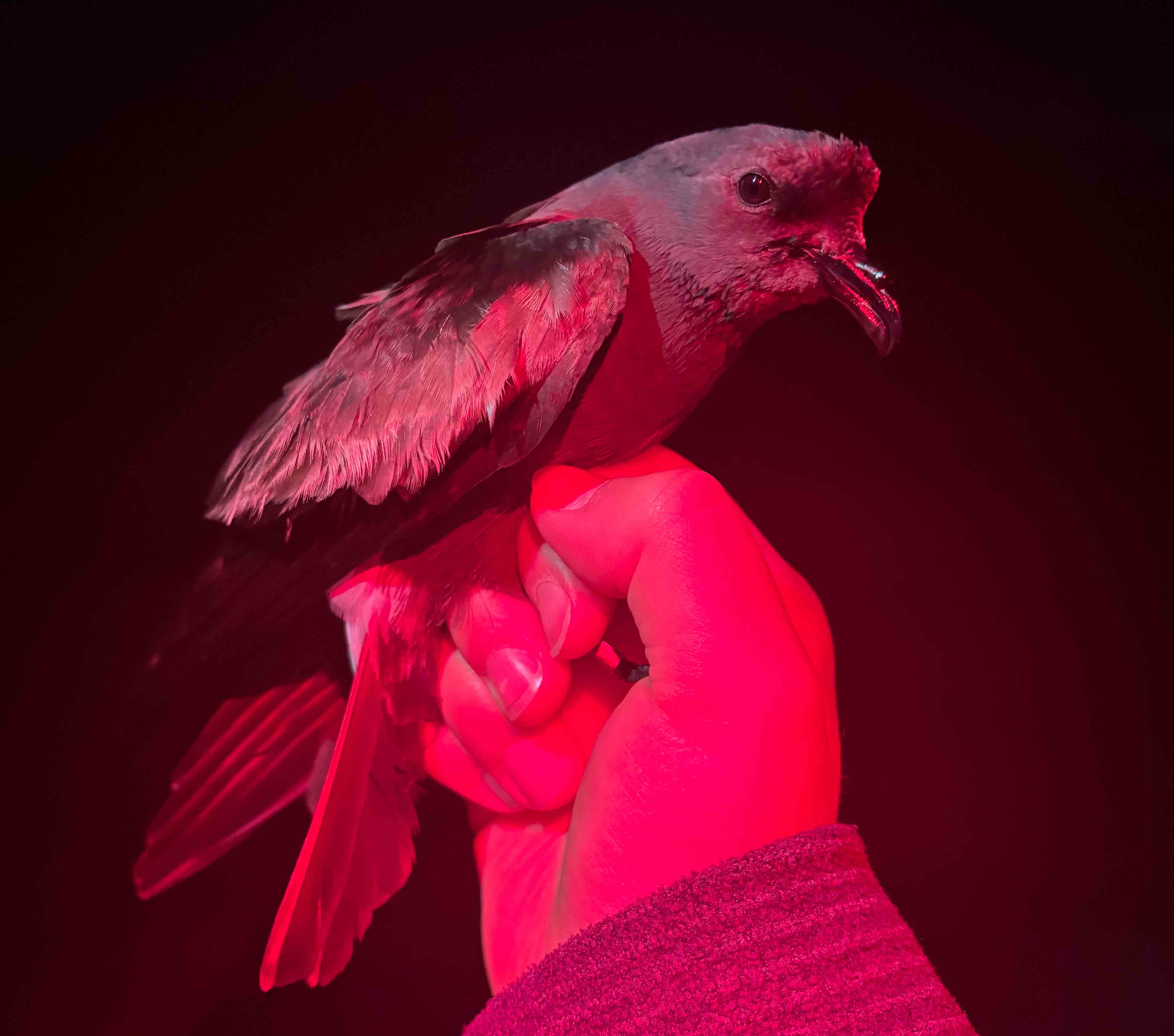
Leach’s Petrel, caught at 1:50am on 30th July, just as I had been about to go to bed! (Carla Hill)
Ringing otherwise has been fairly quiet, though one evening I saw movement from my bedroom window and looked out the window to see AW Tom coming to a stop on a bike with a Greylag Goose under his arm - not what I had expected to see at 10:30pm! He’d spotted it in Wirvie Burn while cycling past and had managed to catch it. I was straight down to the ringing room as I hadn’t ever ringed a goose before or even seen one in the hand. Like most birds, they’re considerably smaller up close than they look in the field! With a little help from Tom as I tend to struggle with bigger rings on my own, we ringed the bird, and upon us finishing it promptly emptied its bowels over the ringing room floor – thankfully waiting until it was no longer on my lap, very kind of it. We took it down to the Obs scrape for release, where it waddled down the bank and swam out into the middle of the scrape.
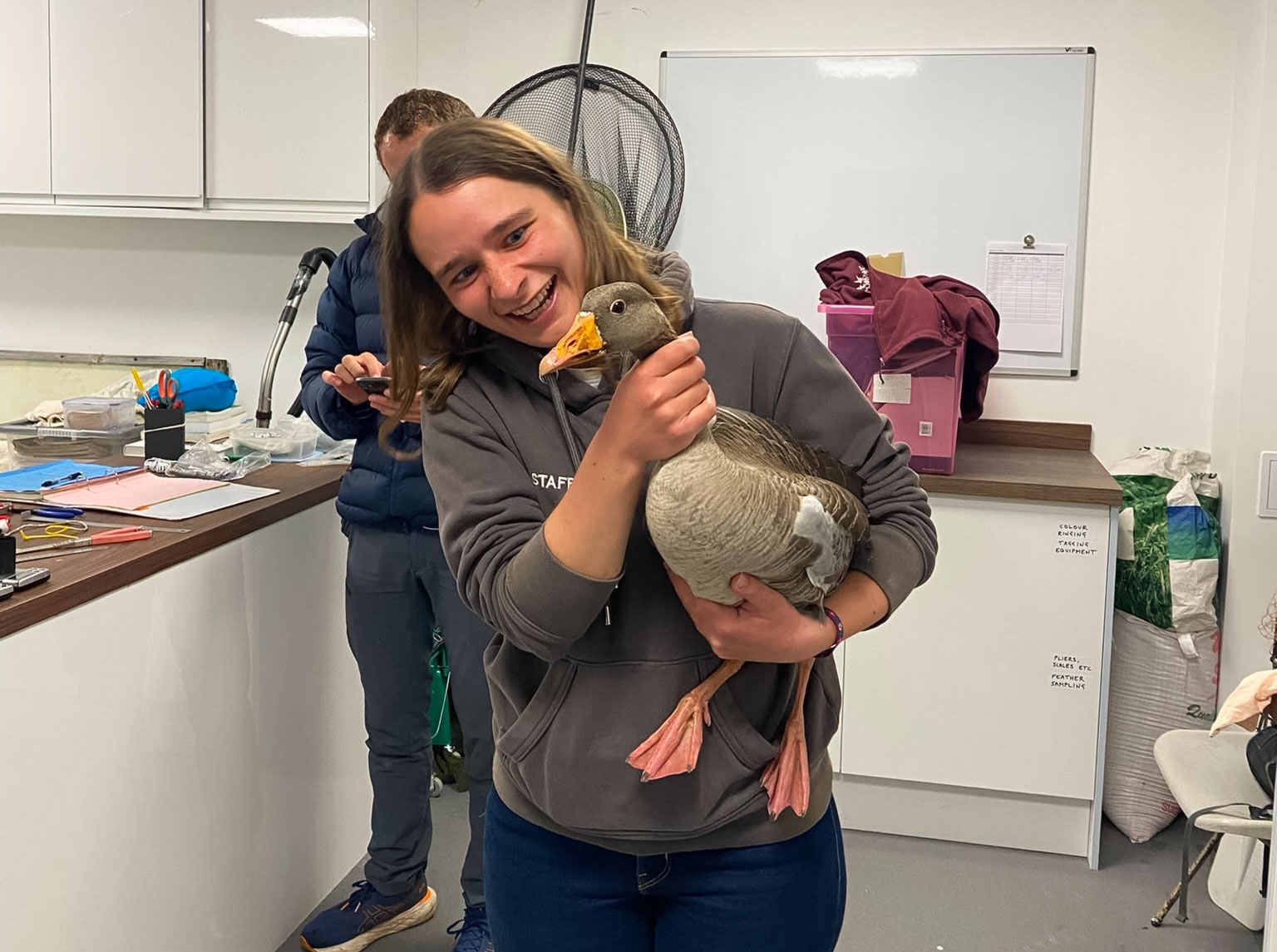
A very happy me with the Greylag (Fen Bowlby)
Back on the 18th, the last cruise ship of the summer, the Scenic Eclipse, came in. It has been the only July cruise ship this year, and came in some lovely weather, though their landing was delayed by several hours due to an exceptionally low tide. Luckily the South Green Puffins were feeling obliging, putting on a show for the cruise passengers as they loafed around on the cliff and those with chicks made their way in and out with beaks full of sandeels and other fish.
The first sheep hill roundup of the year took place on 29th, where all of the hill sheep distributed across the north of the isle are rounded up and bought in to the cru near the airstrip. This is one of only three times a year the hill sheep are handled. The purpose of the first roundup is to clip all the ewes and worm and castrate the lambs, then the second is an attempt at catching all the sheep that were missed the first time soon after, with the third roundup happening in the autumn for the lambs to be taken away. With this being the first roundup, there was plenty of clipping to get involved with, and with me having clipped before it was great to be able to get straight into it this time! My first sheep was lovely and straightforward and was the first sheep I’ve managed to clip without any help so I was pretty happy with that, though my second was much woollier, and therefore much more challenging, and so I had to have some help starting her off. I managed the rest of her with little issue, though she did leave with a rather fluffy neck due to the wool there being so thick! My third and final sheep was exceptionally quick and easy, due to her having lost half of her fleece already! With there being very few left to clip, I didn’t return to help in the afternoon though with us being nearby on Vaasetter ringing Bonxie chicks, we still got to hear the very loud chorus of ‘baas’ as the sheep and lambs were released and lambs all tried to find their mothers within the crowd. Hay baling is also well underway, though the one time I have intended to join so far I (unintentionally) arrived just as they were finishing (and just in time for drinks!).
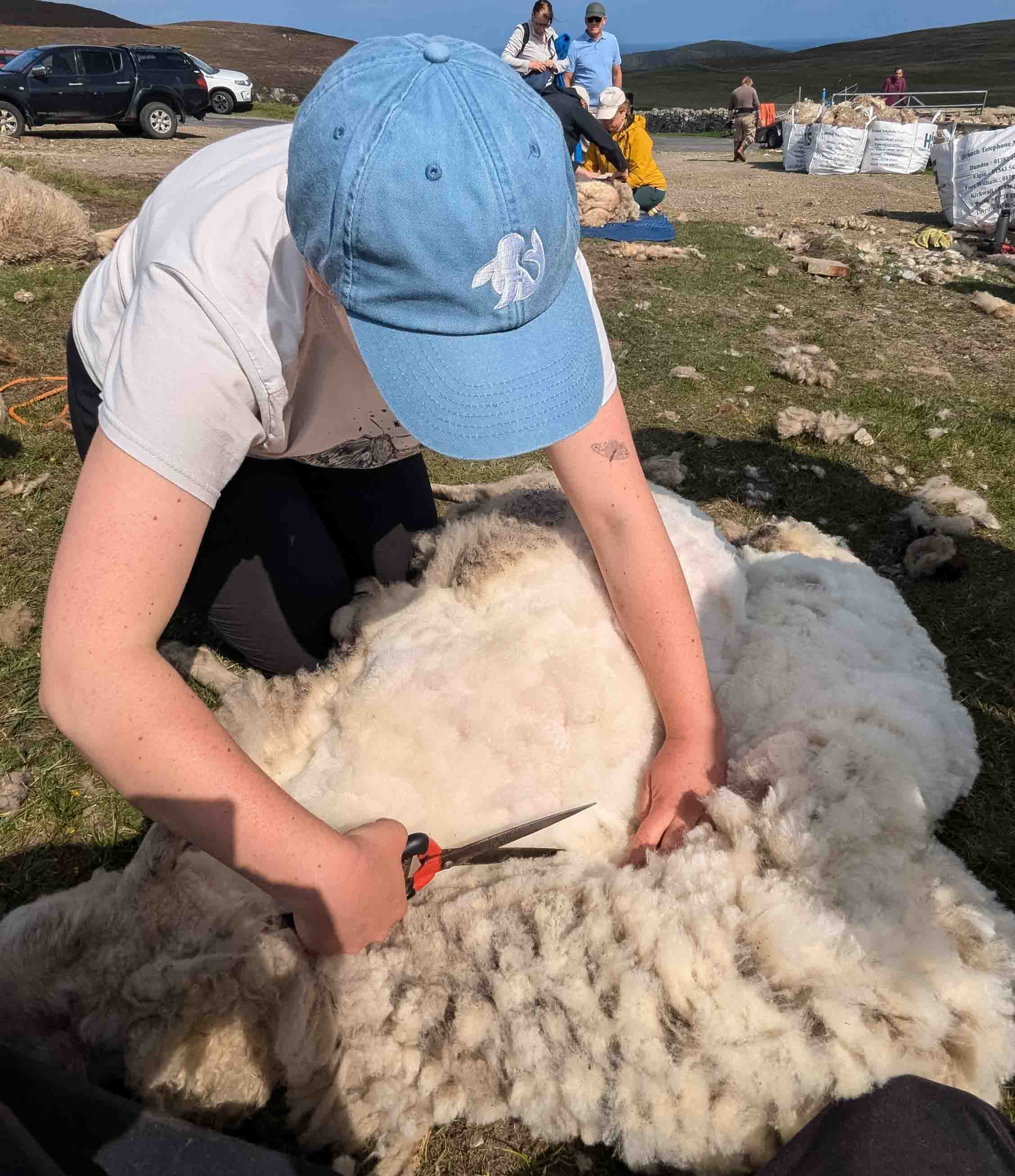
I completely forgot to take any photos during sheep hill this year, so here’s one of me clipping from last year (Jonnie Fisk)
I’ve taken on another new part of my role recently, managing Friends of Fair Isle, which involves keeping the database up to date and managing communications with members, including welcome emails and newsletters. Friends of Fair Isle is an annual subscription, and includes regular newsletters, early access to bookings, and being a vital supporter of the Observatory and the work that we do. Social media has also been going well this month, with one Instagram post showing some of our seabird work gaining the Obs account (@fairislebirdobs if you don’t already follow it!) over 700 more followers, impressive when our follower count had only recently reached over 3000 before that! It’s been a quieter month for talks due to lots else going on, but I’ve now done my second run through of my FIBO History talk which went pretty well.
That’s me over and out for another month, how is it August already?! See you soon for another update!
June
It’s been another busy month on Fair Isle, filled with guided walks, cruise ships and plenty else going on, including our official opening. Seabird work is still ongoing, with chicks beginning to pop up all over the isle, and several nice birds have also been turning up. Here’s what I’ve been up to lately – buckle up, it’s a long one!
We’ve had a much better spell of cruise ships lately, with all but one making it in for a total of six ships landing passengers. One of the cancelled cruise ships did lead to me Shore Watching instead, and picking up a Harbour Porpoise, so that made up for the cancellation. The Puffins have been much more cooperative recently than at the start of the season, with all the non-breeding birds suddenly arriving at the beginning of the month and becoming a more reliable presence, though some cruise ships still saw lower numbers than others. The most memorable ship day of the month goes to the Ocean Nova, which came in on 3rd in some of the thickest fog I’d ever seen. Kudos to the zodiac drivers for getting everyone in, a pretty impressive effort when they couldn’t immediately find the ship again to collect their passengers after dropping the crew on land, and had to be directed by the captain pointing the ship in the direction they needed to go to make it back to south harbour! Thankfully we could just about see the Puffins on Greenholm from South Green, so still a successful day! The Seabourn Venture was also remarkable in its never-ending stream of passengers coming to see the puffins - I’d led the first few to South Green at 2:15pm and they were still coming at 6pm!
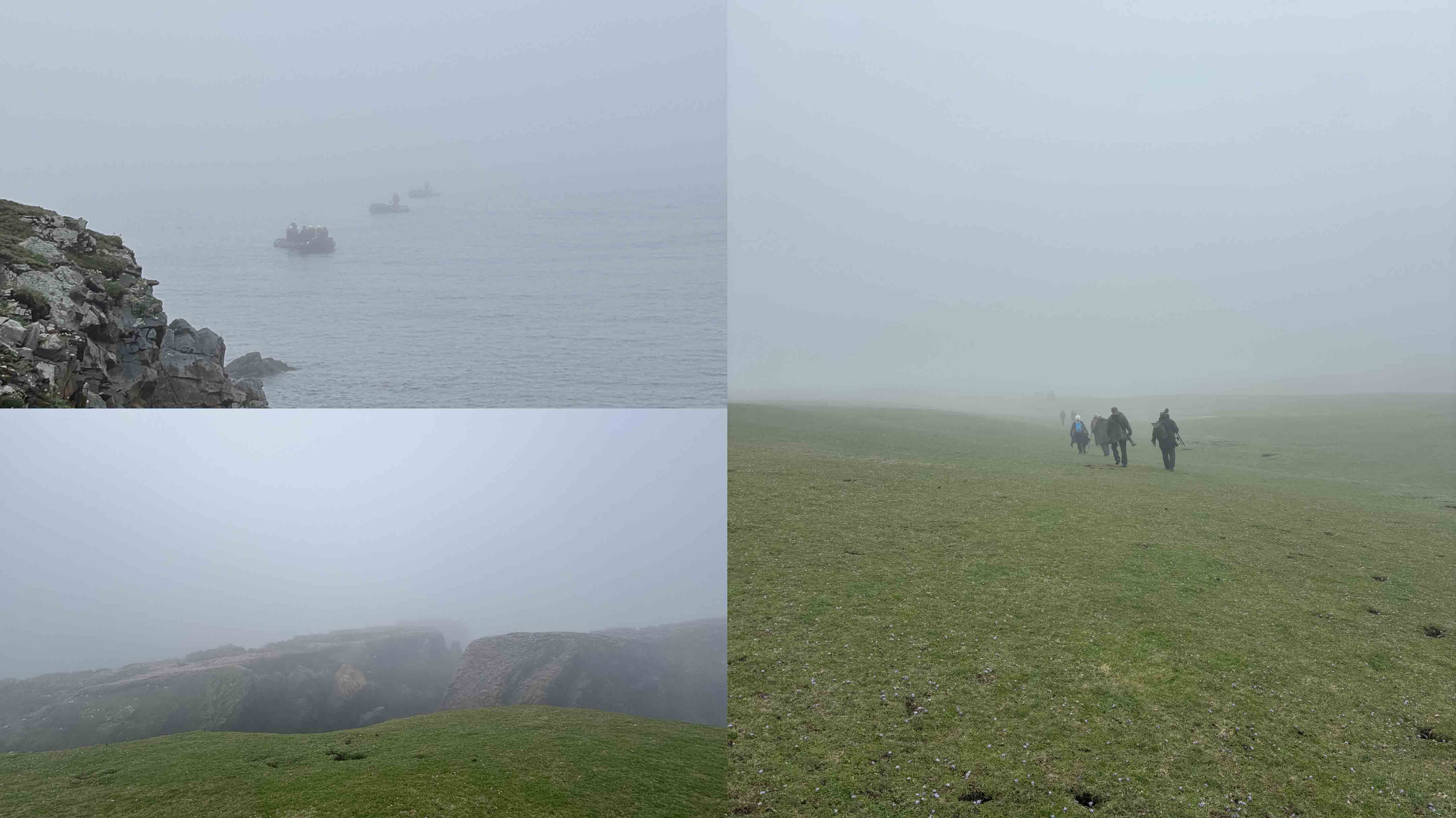
Some extremely foggy conditions made the landing quite an adventure for the passengers of the Ocean Nova, Greenholm was only just visible!
It’s been a bit of a quieter month for guided walks, partly due to the official opening and having the Obs full of people who know the island rather well for a week, but also partly due to some natural lulls in walk interest that come when you have a group of more independent guests who would rather explore on their own. There’s never any predicting how popular walks will be, but as long as I’m not busy with other things they’re always on offer! Recent Puffin Walks have been a success, always the most popular walks I have on offer, and Puffins have been a regular feature on the North Light and Vaasetter routes too. We also had a visit from the tall ship The Flying Dutchman, a ship that came in twice last year and runs almost like a miniature cruise ship, with twenty guests on board. Fourteen of them joined me for a guided walk down to the south, and with many of them keen to visit the shop, some lovely weather, and a tip from hospitality staff Jonnie and Chris that there was plenty of ice cream in the freezer, our brief stop quickly turned into an ice cream break! I’ve been using my guided walks as chance to learn to identify more of the plants and flowers we get around here – I’m getting better, with the help of the app Seek! The isle has been looking spectacular lately with everything out in flower, and it's been interesting watching the variety of flowers changing along my walk routes as we shift from spring into summer.
The first half of June included a lot of plot visits to our Guillemot and Fulmar plots. The Guillemot plots were visited and counted several times, each time with us taking three counts per plot and an average taken to get as close to the true figure as possible - Guillemots are surprisingly hard to count due to the close-together nature of their nesting and it often being tricky to work out exactly how many individual birds are in that small mass of dark brown things you can see! Fulmar plots work a little differently, with three visits and shapes drawn on a photo of the plot to mark occupied ledges. A different shape is used for each visit - I used a circle for my first, square for my second, and a line through the middle for the third. The number of birds present all three times is then counted and we will return later in the summer to mark which ledges have chicks sat on them to get a figure for breeding productivity. Gannet productivity monitoring is progressing well, with a good number of birds now with chicks and several more looking suspiciously like they may be hiding chicks from me. Another big June job is Bonxie nest mapping, walking up and down the Bonxie breeding areas to find nests to allow an accurate count of the breeding population. My areas for mapping were Byerwalls and Hoini, two fairly low-density breeding areas with four or five nests each. Generally I will defend the Bonxies swoopy nature, citing the fact that they are just very protective parents, but one bird on Hoini caught me by surprise as I was stood over its nest logging its location when I felt a large thwack to the side of my head. This was followed by a few seconds of my ear ringing and about 20 minutes of numbness making me briefly question my usual stance that Bonxies really aren’t that bad. Alex, Tom and Luke have also been doing plenty of auk colony work, though I’ve been busy with other things a lot of the time so have only managed to join them for a morning of Puffin colour ringing so far, where we caught three birds.
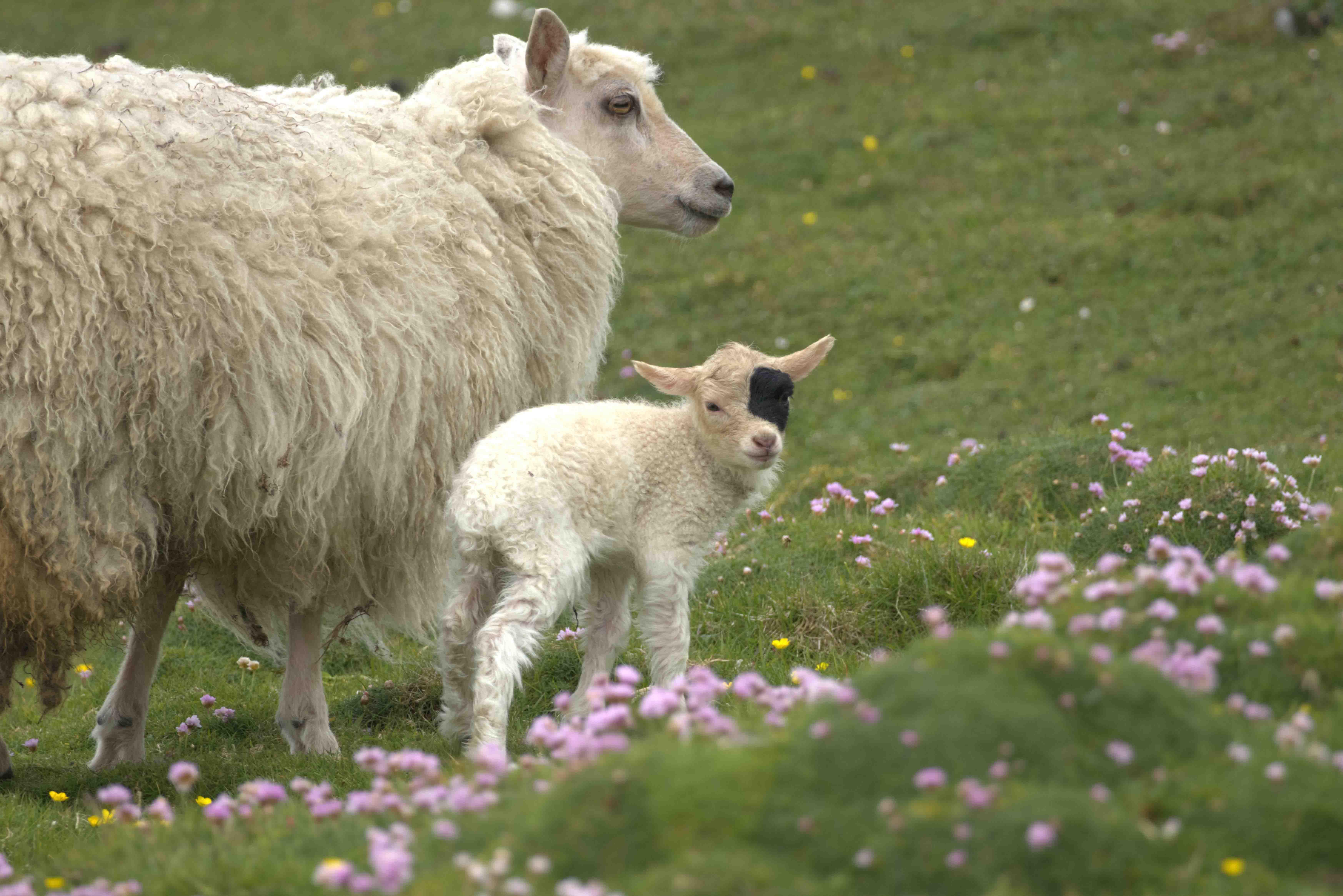
One of my Gannet visits resulted in the discovery of a new Pirate Lamb on Dronger, which many were pleased at the news of due to the recent loss of Pirate Sheep, who had roamed the area around the Haven for the past decade.
I’ve completed a few more shifts in the Museum, though my shift on the 19th was cancelled due to this being the Museum’s 40th anniversary of opening, and it being open for celebrations later on. After almost being late due to the sighting of a couple of Orca (which I very briefly saw), it was a lovely way to end the afternoon with the Museum open for all to come and celebrate (with some Prosecco of course!), and testing the limits of how many people can fit inside at once. Incredible to think how it was once the community hall, and with an island population bigger than today’s - social events must have been rather cosy! It was lovely to see such a great turnout for the event and to hear Anne speak of her years running it. I was appointed photographer for the event, so spent my time balancing a glass of Prosecco in one hand and my camera in the other.
The museum opening fell amongst events organised for the Observatory grand opening, including a talk by islanders Dave Wheeler and Jimmy Stout covering an amazing array of photos they had taken or acquired over the years, and another by author Ann Cleeves the following evening. Saturday 20th brought the opening itself, though my day began with meeting a cruise ship and taking the passengers up Buness to see the Puffins, then clock-watching to make sure I was back at the Obs in time for the first opening speeches of the day. Opening speeches by Ann Cleeves and director Karen Hall and the plaque unveil were done twice, once before lunch for those who had day-tripped in for the event, and once again in the evening for all the islanders. Lunch was an impressive buffet spread put together by the kitchen team, featuring two of my favourite things – Nair’s homemade doughnuts and a giant wheel of Brie. Dinner was buffet leftovers, then we were treated to another buffet alongside a rather impressive FIBO logo cake by Eileen and Neil in the evening. The evening also saw the official opening of Kenny’s Bar, with a speech by Deryk Shaw and Ian Best. I was in charge of filming all of the talks and speeches on a fancy little camera belonging to Marie, a job that mostly went well until I realised the camera was in completely the wrong place for the bar speech, leading to a rather chaotic minute of film as I tried to make the best of the situation. The weekend concluded with a Sunday evening FIBO-themed quiz written and hosted by me, with six teams battling it out for the prize of a box of Heroes and some Tunnock’s Teacakes. The results were incredibly close, with only 3.5 points separating first and last place, but a team consisting mostly of Obs staff took the victory, helped considerably by the art round in which they gained an extra five points after their depiction of the Obs was voted the winning piece by my family, who were judging from afar.
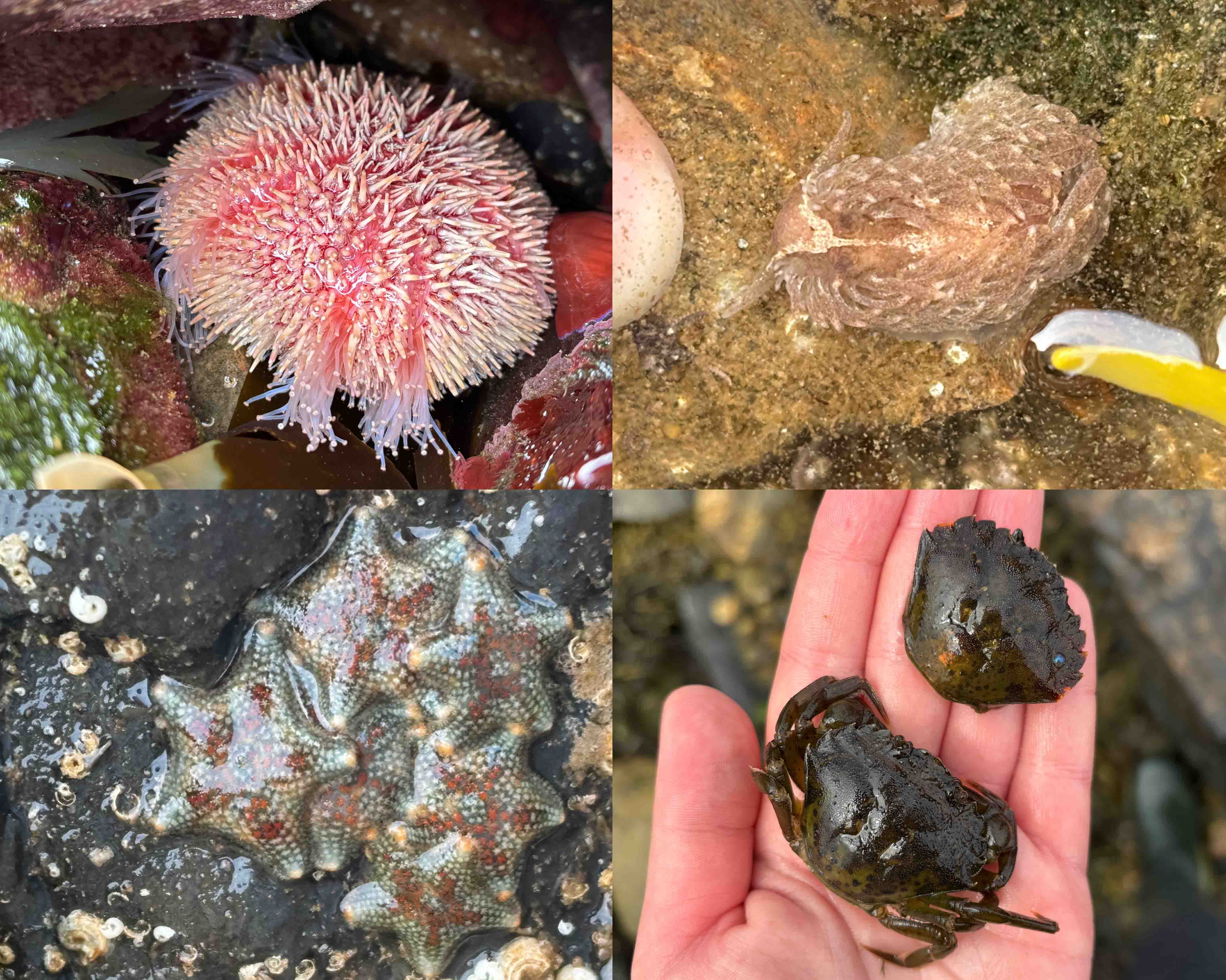
Our rockpool school session findings – Sea Urchin, Grey Sea Slug, Cushion Stars, Shore Crab with its recently moulted shell.
Since my last update, I have completed two further sessions with the school. The first was a rockpooling session, something we try and do fairly often and that the kids (and I) thoroughly enjoy. This was the first school session where we were joined by nursery pupil Brodie, and he did a great job navigating the slippery rocks. We found a few nice things, including several Grey Sea Slugs, a couple of soft-shelled Shore Crabs who had just completed their moult and were waiting for their shells to harden up again, several Small Cushion Stars, a few Brittle Stars and a Sea Urchin, whose wiggly tube feet we could see moving around under the water. Luca and Ander also found a fish in a large but shallow pool but unfortunately it evaded capture and refused to give anyone good views, so we had to accept it as one that got away. Our second school session of the month was inspired by NASA’s Landsat programme, where you can type words and get them back in satellite images that look like the letters (you can see what I mean here: https://science.nasa.gov/specials/your-name-in-landsat), so we set off on the northbound road towards Furse and kept a close eye on the surrounding landscape to see if we could find the alphabet. I was once again joined by all four children and they all got quite creative, with letters found in the sea, heather, wool, and shapes of pools among other things. We then returned to the Obs to import the images into my laptop and make the kids names from our new Fair Isle alphabet. There are plans to use this in the school for name labels and to have the full Fair Isle alphabet up around the walls of the nursery!
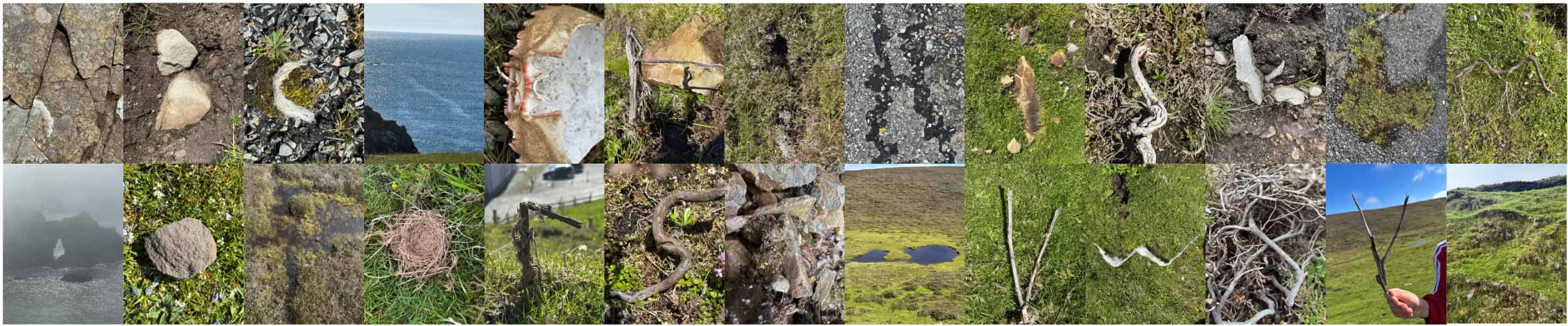
Our Fair Isle Landsat alphabet.
Talks this month have run slightly differently to usual due to the opening week talks, but the month began as usual, and Luke and Tom both did a great job of their first talks of the year - Luke on The Fair Isle Birding Year and Tom on Migration. We’ve also had more wonderful guest talks, the first being from Ava Jenkins of the Darwin Tree of Life Project, who was visiting to take blood samples from new bird species in order for the project to sequence their genomes. We managed to catch her a few birds whose species were new to the project, including Bonxie, Fulmar and Crossbill, so it was a very productive visit for her! Our next guest talk was by visiting birder Ollie Metcalf on some acoustic recording and conservation work he carries out in the Amazon Rainforest, complete with videos and sound recordings of some of the species he comes across there. It was then over to the opening talks for the following week, and the month ended with Alex starting the Ornithology team's talk rotation second run-through, and a guest talk In Defence of the Fulmar by Jonnie, which had him making quite the entrance dressed as a judge!
Summer can be a quiet time for birding, but it can also bring some nice surprises with it, and we’ve had some great birds this June. The month began with a Golden Oriole around the Kirn o’Skroo. Brief attempts to see it on the way back from a guided walk to North Light were unsuccessful as it was a rather mobile bird, but I was pleased to catch up with it later on. A Bee-eater almost missed by all of us on the Ornithology team as we’d been trying to catch some Bonxies for GLS tag retrieval brightened up the middle of the month, and a Serin I caught up with on my way back from a guided walk with some guests to South Light (where they stayed for lunch) was a new bird for me. Unfortunately, I narrowly missed the Long-tailed Skua due to being out Gannet productivity monitoring and despite my efforts to pick out the bird on the airstrip from the top of Lerness, the heat haze was too much and with the plane due in imminently, I had to accept defeat. However, the Trumpeter Finch at the Kiln o’Skroo more than made up for this, as despite initially missing it, I got some great views when I returned later on. My other birdy highlights of the month were an afternoon ringing wader chicks, mostly Lapwing, but also my first Redshank, and stepping out of the shower one morning to see my phone ringing to inform me that they had just caught a Nightjar and it was mine to ring. I was dry, clothed and in the ringing room within 4 minutes!
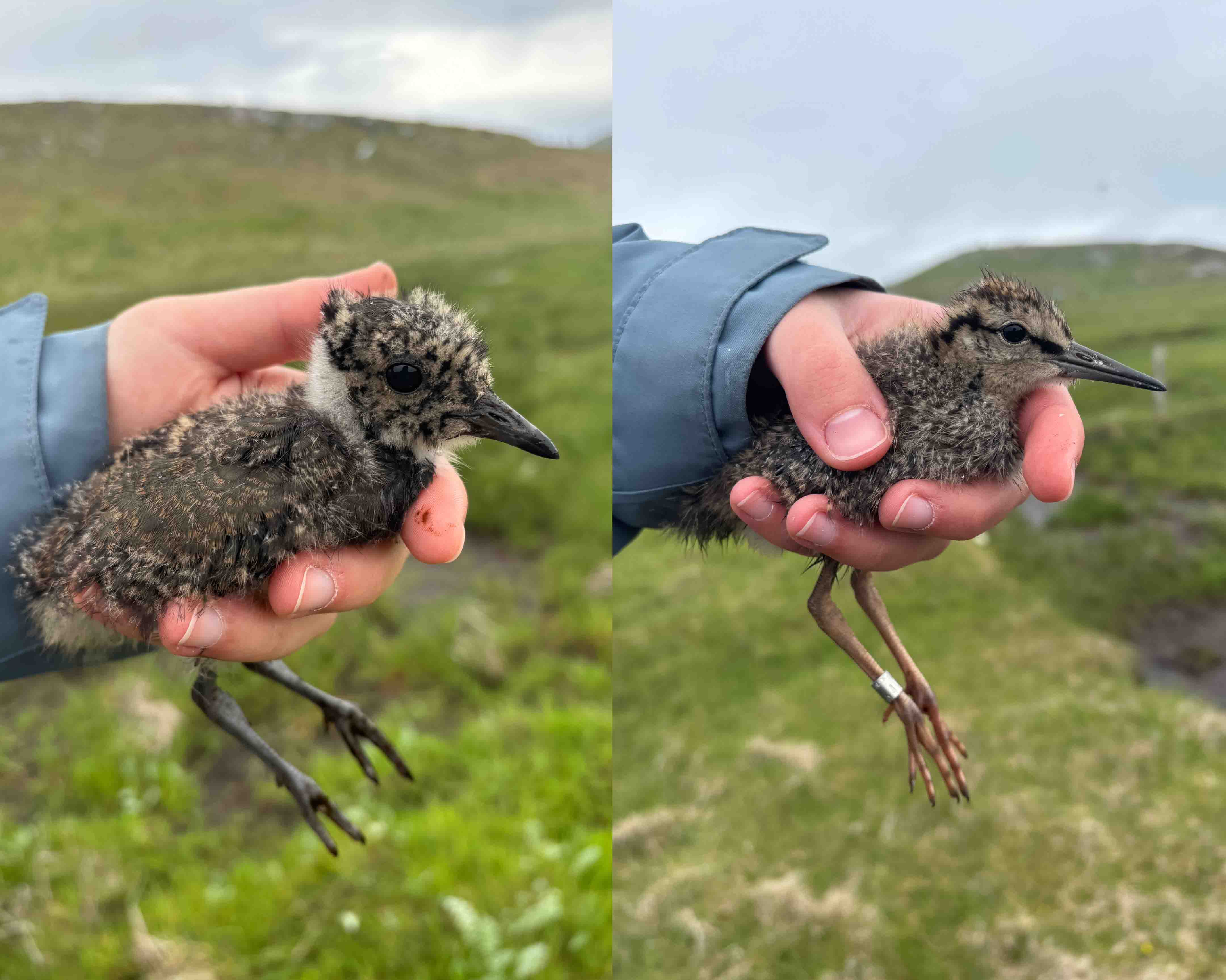
Wader chicks are always the cutest little bundles of fluff (left Lapwing, right Redshank)
I’ve been spending my free time getting as much lamb time in as possible before they’re all grown up, which meant helping bottle feed the lambs at Burkle at every possible opportunity before the milk powder ran out and they were completely weaned. I quite enjoy working with livestock, and part of my most recent afternoon off was spent helping the Shaws clipping some of their sheep. I did a sheep and a half, taking my total sheep clipped ever up to 4 – bring on the hill caa and more clipping! Clipping unfortunately coincided with the finding of the Trumpeter Finch, with us all halfway through sheep at Del’s announcement of its finding, so once we’d finished it was a quick drive up to North Light where the bird had since gone missing. Luckily we all managed to catch up with it later on, on a lovely evening for a twitch at North Light.
See you all next month!
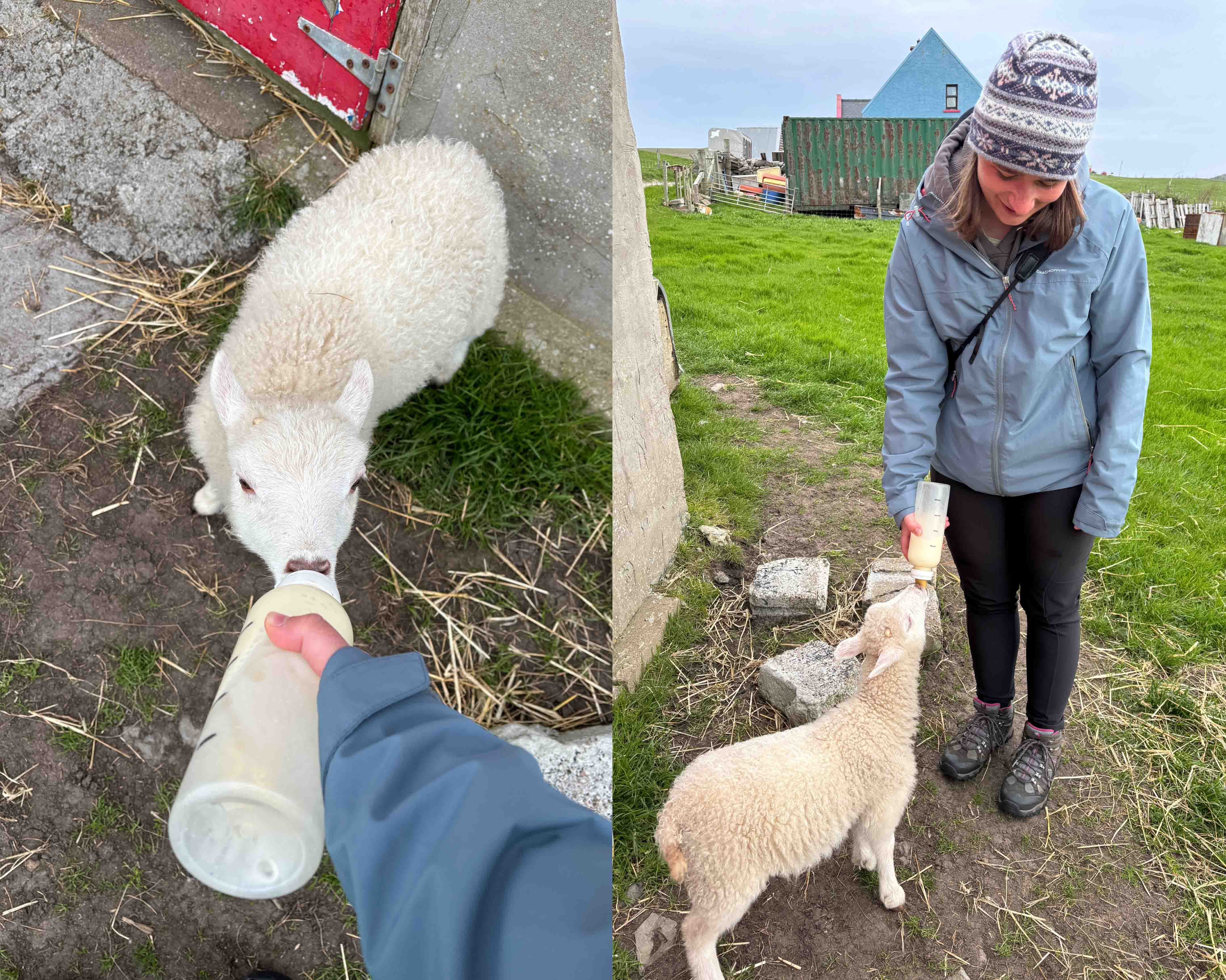
Me giving Peter Rabbit, the rescued abandoned hill lamb, one of his last bottle feeds.
May
May has been a busy month with plenty to keep me occupied, with steadily increasing numbers of guests, cruise ships, a visit from my parents, and all sorts else!
One of my first jobs at the start of each month is going round the isle and checking on all of our biosecurity boxes. With this month’s check closely following news of a rat on Mousa, I was keeping my fingers crossed that we would not suffer the same fate, but luckily, we were all clear. The biosecurity monitoring is done using chocolate-flavoured wax blocks, and any sign of rodents is recorded. Here, our resident mice like to have a nibble at the blocks, but they aren’t cause for any concern.
I’ve packed in a good number of guided walks in the past few weeks, covering all of the routes I offer and with a few evening Puffin walks. The Puffin walks have varied from no birds on land to lots coming in as soon as we sit down to wait, with the latter leading to lots of happy guests! A few of my longer walks have been particularly memorable for falling on days when we’ve had good birds turn up, including one where a Bluethroat and a Western Subalpine Warbler at Barkland were located either side of a wall, both visible at the same time from where we stood, and at one point were both in the same ditch! Another particularly notable walk day was the day the Northern Parula turned up. I had been about to leave with a guest for a guided walk to North Light when Tom put out the news, so the walk quickly turned into a twitch followed by a walk around the south-west coast instead, with plenty more nice birds to see, including a Cuckoo that then spent the latter part of the afternoon (after I’d gone back for seconds of the Parula) teasing me by landing close in front of me but never giving me a chance to photograph it!
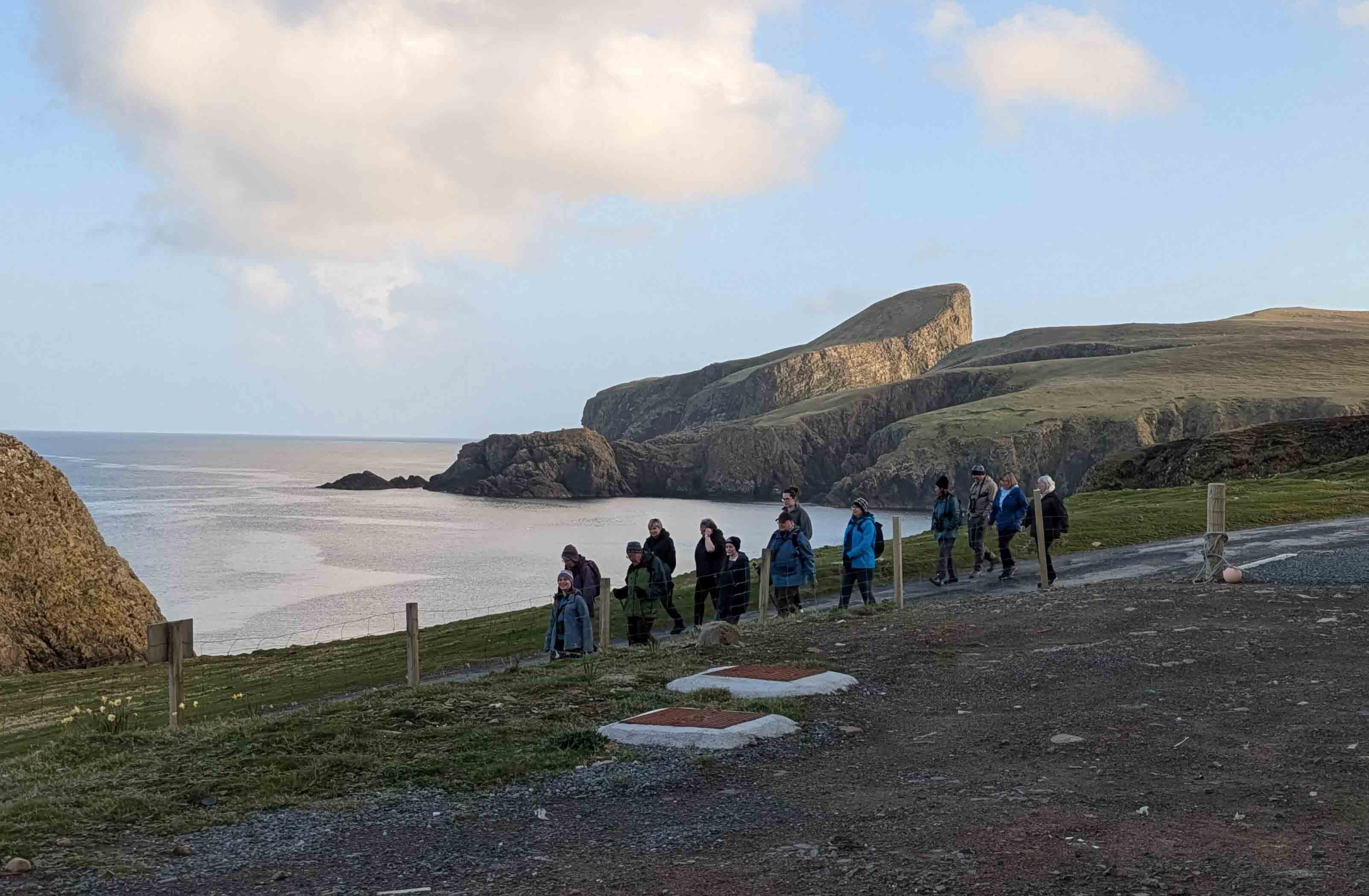
An impressive turnout for a Puffin walk, luckily coinciding with an impressive Puffin turnout!
We’ve also now had the first few cruise ships of the season, though of the six that have been so far, only three have actually managed to land passengers – not a great success rate this early on! I always enjoy cruise ship days, so it’s good to have them back again – they’re a great opportunity to chat to people from all over the world and to really test your Fair Isle knowledge when passengers ask you questions such as how many vehicles are on the isle! The Puffins have turned out in varying numbers each time to delight the cruise ship passengers, many of whom were seeing them for the first time. Each time a ship comes in the Hall and Museum open, with the Hall set up for knitwear and artwork sales, and with a delicious array of cake available (always my first stop after a cruise ship puffin walk!) alongside hot drinks. There’s always a lively buzz about the Hall when its full of cruise passengers, and this year has been particularly nice as the Observatory now holds a stall selling merch, where I will go and help Ruth with questions and sales once I have finished with Puffin walks and nabbed a slice of cake.
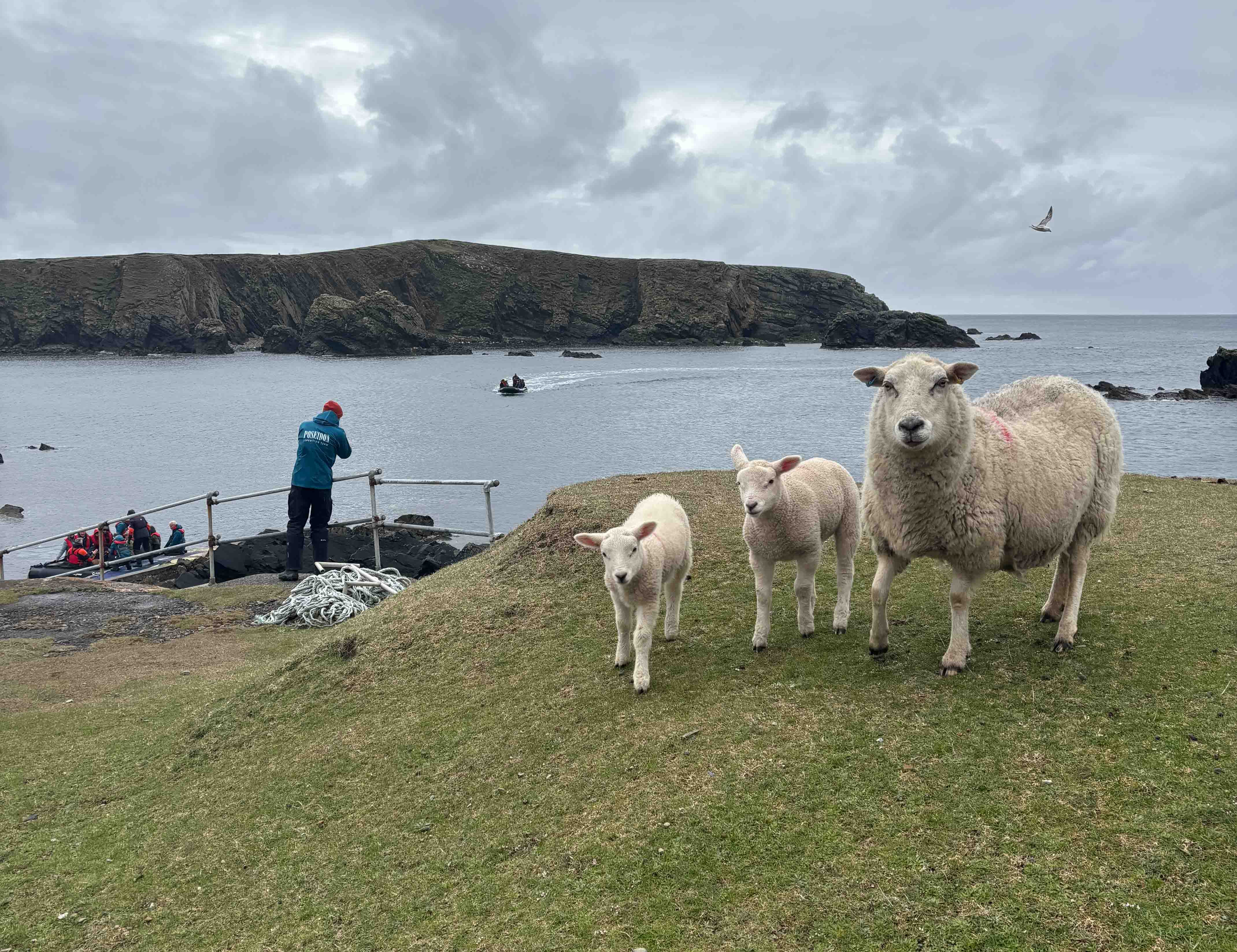
This ewe had a lot to say about the arrival of the first cruise ship of the year...
I have completed three sessions with Fair Isle Primary School so far this season, and all three have been a big success with the three kids in the school. Our first session included a walk around the south of the island during which I had set the children the challenge of finding something beginning with every letter of the alphabet, whether it be birds, plants or other parts of nature. They put in a very good effort, finding things for all but six letters of the alphabet, and even managing some of the trickier ones! Our second session focused on bird ringing, with the kids and their teacher Jonathan joining myself and our Head of Ornithology Alex for a trap round. The school’s headteacher was visiting at the time so she also joined us, and it was great to be able to introduce her to some of the work done by the Observatory. After pushing the traps we returned to the Obs where AWs Tom and Luke had opened the nets in the garden, leaving us with five birds (two Chiffchaffs, two Blackcaps and a Sedge Warbler) to show the children being ringed and for them to get to release afterwards! Our most recent session was a beach clean of the school’s adopted beach at Muckle Uri Geo in collaboration with FIMRO, with data collected for the Marine Conservation Society. 4kg of litter was collected, made up of 103 pieces, by a very efficient team of 20 volunteers!
This month has also seen me take up a new role on the island, learning the ropes to be able to open the Museum. Fair Isle has an impressive history for such a tiny place, and there’s a lot to learn! I now have a regular Friday slot opening the Museum for an hour and a half. I’ve only done it a couple of times so far but I’m already starting to learn a little more each time and become more confident in what I do know.
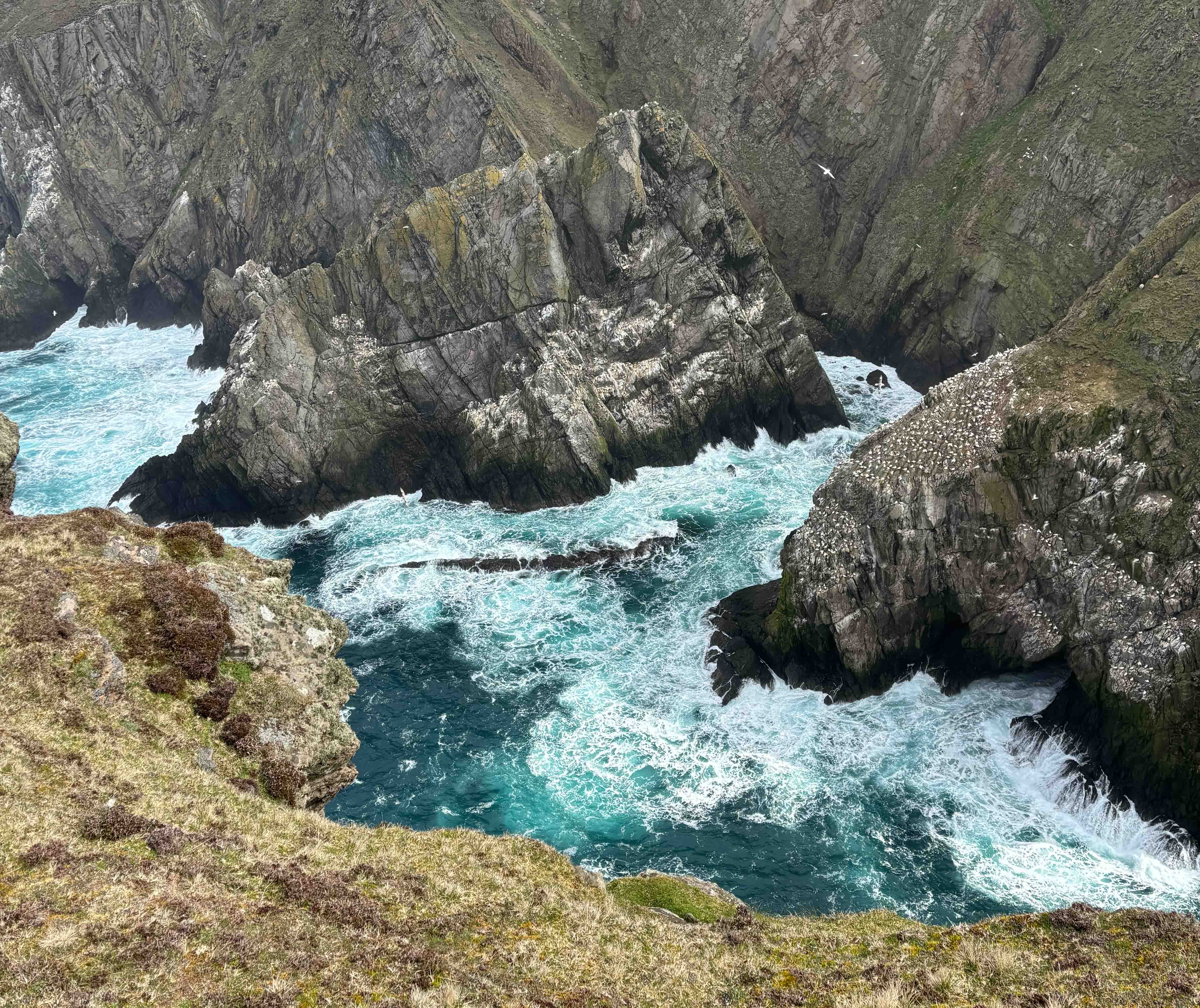
Choppy seas by my Gannet plots!
Seabirds are slowly starting to occupy more of our time as the first species have begun in this past month to settle down and start to lay eggs. Each of us on the Ornithology team has a species we carry out breeding productivity monitoring on with regular checks. My productivity species is Gannets, of which I have 5 plots totalling around 300 nests that I check every 7-10 days. I’ve completed three visits to my plots so far this year, and it’s a little early to be able to say how they are doing, but I have seen a good few birds on eggs.
Something else that has also begun for the season is our regular talk schedule. Our first talk was on 19th May, and the plan is to continue with talks either by members of the Ornithology team or by guest speakers occurring every Tuesday and Friday evening after Log. So far, we’ve had three talks, the first week starting with Alex giving what will be his regular talk on the Seabirds of Fair Isle, and a guest talk by artist Kat Owens about her project Entangled and Ingested. Kat’s talk focused on the effects of plastic on marine life, and her artwork uses single-use soft plastic to create life-size works of marine species that have been found entangled in or having ingested plastic, including several whale species making for some very large pieces of work! The talk was followed by a workshop in which those who attended the talk were able to contribute to Kat’s biggest piece of work yet, sewing plastic to the fabric backing of a 10x6ft portion of what will be an 80ft long Blue Whale! I have also delivered my first talk of the year, one on the history of FIBO that I’ll be giving on a regular basis. I usually enjoy giving talks, and once I’m in the flow I tend to get quite into them, and this one was no exception!
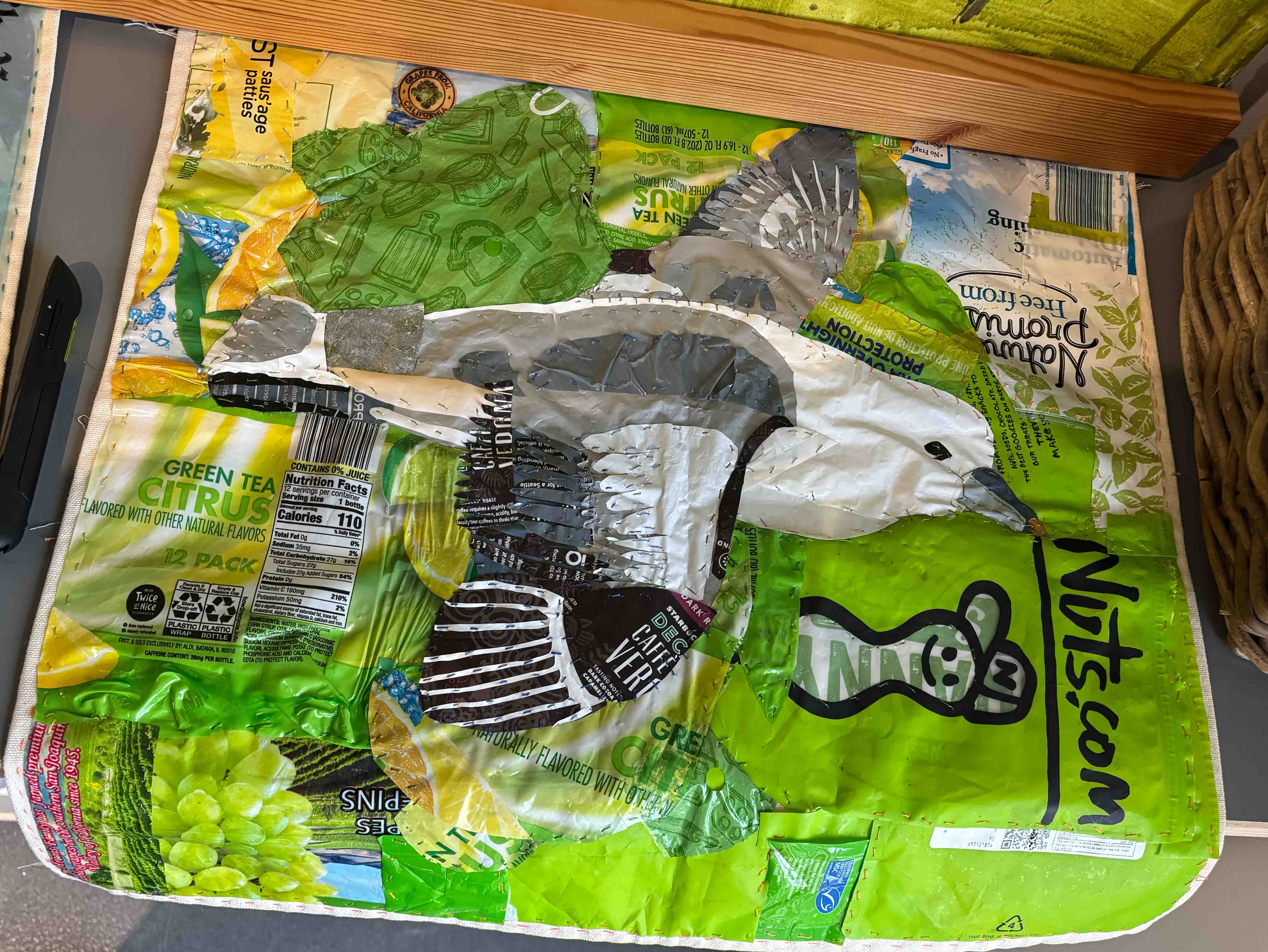
An example of one of Kat's pieces, a Fulmar made out of single-use plastic.
Other birdy highlights not mentioned include Fair Isle’s first record of Spoonbill, two individuals found by Tom as they landed, and which stayed on Da Water only just long enough for us to make it with a few guests from the Obs! The past week and a half have been exceptional, with several Bluethroat, a Red-throated Pipit found by Luke at Field just as I was passing on the way back to the Obs after a cruise ship, a Thrush Nightingale found by Tom at Setter, and of course the Northern Parula deserves another mention, bird of the season so far, and what a run of good finds Tom is having!
I’ve not fitted in many Shorewatches recently, and those I have managed have been pretty quiet, though one afternoon immediately upon my return to the Obs after completing a couple of watches, Luke, who was just heading out, picked up a large pod of Risso’s Dolphins heading for Buness. The timing was slightly frustrating, but I couldn’t be annoyed for long when I realised how slow they were moving and that I could catch them off of Buness! This led to a pretty incredible and unusually long encounter with a nursery pod complete with several calves! The best views of Risso’s I’ve had yet and a big highlight of the month for me. A visit from my parents and getting to spend a few days showing them around the island I’ve told them so much about was also welcome – they found Fair Isle a little cold and hilly being used to very flat Norfolk but loved it! They also helped me test-run the Fair Isle Monopoly I spent my free time working on last year, which is now playable in the Obs bar! Since the last update, we have also carried out both our BBS surveys for the year and got the Oysterplant fence up by South Light with the help of housekeeper Maebh to protect the Oysterplant from the sheep, plus I’ve had my first T-shirt weather days of the season! The next few weeks should bring a bit more seabird work, more cruise ships, and the first evening talks for the Assistant Wardens, rounding off the first of each of our four regular talks!
See you next month!
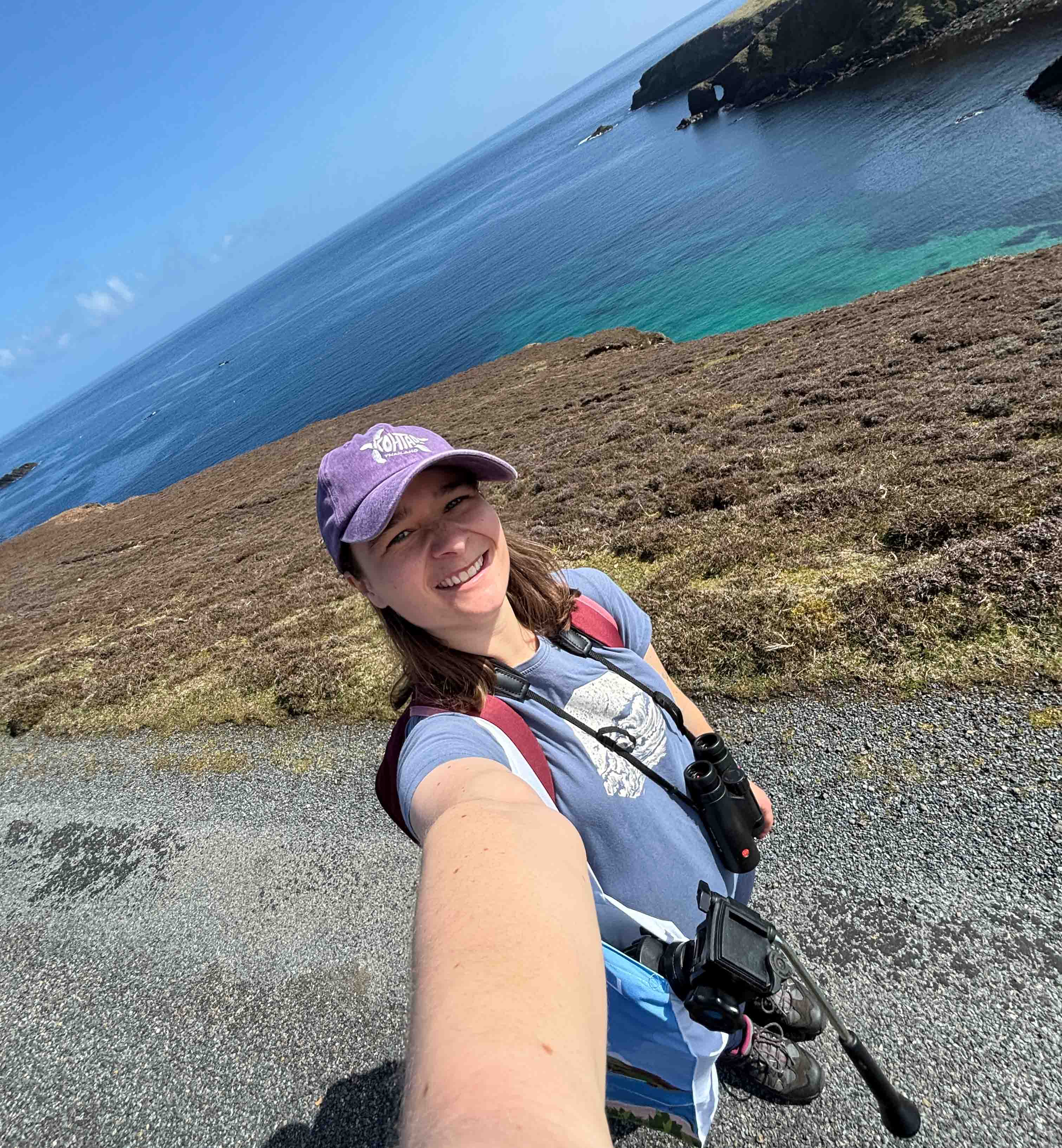
A happy me after Gannet plots on a warm and sunny afternoon.
April
Hi everyone! I’m Carla, I was Ranger last year and loved it so much I’m back again for the 2026 season! It’s great to be back on Fair Isle, and within a day of being back it felt like I’d never left. We have the whole staff team from last year back which means we’ve all settled back into a routine very quickly, running like a well-oiled machine even after a few months apart.
After being stuck on Shetland for two days (staying with Karen, one of the FIBO directors who generously fed and housed AW Tom and I for the time we were stuck while her new puppy kept us entertained!) and fearing not making it over due to a lot of snow in the morning, it was a relief to make it back and to reacquaint ourselves with the lay of the land with a walk around the south road loop. A Greenland White-fronted Goose by Skerryholm was a nice start to the season.
So far, it’s been a busy few weeks of mostly indoor jobs for me, following on from some display board content I put together at the end of last season, so I’ve spent several hours guillotining and laminating and guillotining again before sticking Velcro to the back of each piece of text or photo. My next job was arranging these Velcro-ed parts on the boards then walking away quickly before I can scrutinise how straight (or not as the case may be) each element is. I’ve also been working on some talk slides for the coming season as we work on getting a regular talk schedule up and running, in between other odd jobs.
It’s been a windy start to the season, making for a slow start bird-wise, but also limiting opportunities for outside jobs. On the few calm afternoons we’ve had, it’s been nice to get out and help our Assistant Wardens, Luke and Tom, with some jobs around the isle, including translocating some irises to the Obs Scrape that had been dug up from the Walli Burn to prevent it clogging up, and fixing the catching box on the Double Dyke trap after a disastrous escape by a Black Redstart a day earlier. We’ve also partially rebuilt the Gully trap, a big job that took several afternoons, and spent a couple of afternoons spreading seaweed on the Skadan crop in the hope that it will fertilise the soil and help the crop to grow with more success than last year. Some calm mornings offered an excellent opportunity for Tystie surveys, the east coast one morning and west coast the following morning – two very early starts in a row for the Ornithology team! Tystie surveys are slightly unconventional in that they are carried out by shouting down cliffs. This encourages the birds out of their deep and inaccessible nesting cavities down the cliffs and onto the water, where they sit patiently to be counted, the large white patches on their wings standing out against the sea surface. In terms of birds, the highlights so far have been a White-billed Diver and a Woodlark, and I was also very happy to get to ring my first Snow Bunting!

A view well worth the 5am alarm during the west coast Tystie survey!

Snow Bunting in the hand, one of my favourite birds and one I was very pleased to get to ring!
In terms of more Ranger-y outdoor jobs, I’ve done my first biosecurity box check and my first Shorewatches of the year. I’m pleased to report that we remain rat-free, and my first venture to the South Light shorewatch site (somehow I only did Buness shorewatches all season last year) resulted in a Porpoise sighting! I have also completed my first few guided walks of the year, including testing a new walk route up Vaasetter. This is a part of the island I don’t venture to often enough, and I forget how good the view from up there is, besides it’s also pretty cool to see Sheep Rock up close! I’m excited to get up there a bit more this year, if I can work out a route around the Bonxies in the summer!

One of the best views over Fair Isle, from the top of Vaasetter
We’re having a bit of a competition between the obs staff this year – who can see the most bird species this season? Our whiteboard in the staff corridor is covered in some very long tick lists, one for each member of staff, and when something new is spotted a queue often forms as everyone heads to update their list. As expected, the wardening team have begun leaps and bounds ahead of everyone else, their mornings spent on census giving them a distinct advantage. Though my list is slowly growing, I’ve still got some catching up to do – bring on more guests and more guided walks!
Puffins have been returning in dribs and drabs, with the first on land of the year spotted on 9th April, and numbers of other birds such as Wheatear and Bonxies are climbing. I’m eagerly awaiting the first Arctic Skuas of the year, my favourite Fair Isle species, and due any time! It also won’t be long before the first cruise ship arrives in early May – here’s hoping I keep up my puffin success rate of last season where I managed at least a couple of puffins for every ship that came in!
See you all soon for another update!

Back in one of my favourite spots with the Buness Puffins